
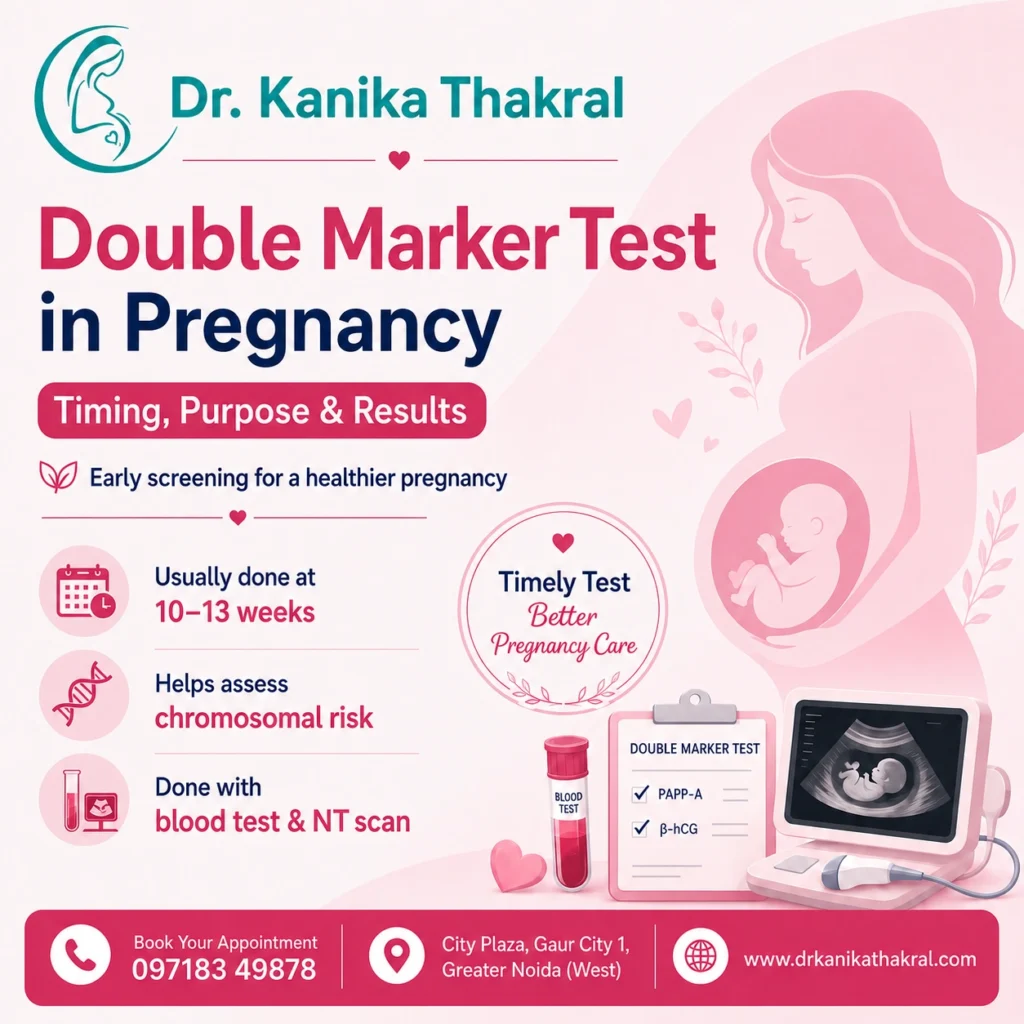
Double Marker Test in Pregnancy: Timing, Purpose and Results
The Double Marker Test in Pregnancy is one of the important screening tests advised during the first trimester. Many expecting mothers hear about this test during their early pregnancy visit and feel worried. However, this test is not suggested to create fear. It is advised to understand whether the baby has a low or high chance of certain chromosomal conditions.
This test is usually done along with an NT scan. When both reports are checked together, the doctor gets a better idea about early pregnancy screening. First-trimester screening commonly includes a blood test and an ultrasound between around 10 and 13 weeks of pregnancy.
At Dr. Kanika Thakral’s clinic, the aim is to guide every mother in a simple and calm way. Pregnancy reports can look confusing, but with the right explanation, they become easier to understand. Good Pregnancy Care always starts with timely tests, proper counselling and regular follow-ups.
What Is Double Marker Test in Pregnancy?
The double marker test is a blood test done during early pregnancy. It checks two important markers in the mother’s blood. These markers are Free Beta-hCG and PAPP-A. Their levels help the doctor assess the chance of chromosomal conditions in the baby.
The test mainly screens for conditions like Down syndrome, Edwards syndrome and Patau syndrome. These conditions are related to changes in the number of chromosomes. The test does not confirm these conditions. It only tells whether the pregnancy falls under a low-risk or high-risk group.
This is why the double marker test should always be understood with your gynecologist. A report may show numbers, ratios or risk categories, but the actual meaning depends on many things. Your age, pregnancy week, NT scan report and medical history all matter while reading the result.
Why Is the Double Marker Test Done?
The main purpose of the double marker test is early screening. It helps the doctor understand if the baby has a higher chance of certain chromosomal conditions. If the result is low risk, it gives reassurance to the parents. If the result is high risk, the doctor may suggest further counselling or additional tests.
This test also helps in planning pregnancy care better. It gives useful information at the right time, especially during the first trimester. Early information allows the doctor and parents to take the next step calmly instead of making decisions in a hurry later.
If you are searching for the Best Gynecologist in Gaur City, Dr. Kanika Thakral can help you understand why the test is advised and what the result means for your pregnancy. Every pregnancy is different, so the same test report may not have the same meaning for every mother.
Best Time for Double Marker Test in Pregnancy
The timing of this test is very important. The double marker test is usually done between 10 weeks and 13 weeks 6 days of pregnancy. It is often planned along with the NT scan, which is done during the early pregnancy scan window.
The NHS also explains that combined screening includes a blood test between 10 and 14 weeks and an ultrasound scan between 11 and 14 weeks. If this time window is missed, another screening option may be suggested depending on the pregnancy week.
Your doctor will first confirm your pregnancy duration. This may be done through your last period date and an early ultrasound. If your periods were irregular before pregnancy, the pregnancy week may need to be checked more carefully. Women who had Irregular Periods Treatment before pregnancy should follow the doctor’s advice for early dating scan and test timing.
Is the Double Marker Test Compulsory?
The double marker test is not something that is forced on every mother. However, it is commonly advised as an important screening test during early pregnancy. Your doctor may recommend it based on your age, pregnancy history, scan findings and overall health condition.
It may be especially important if the mother is above 35 years of age, had a previous pregnancy with chromosomal concerns, has a family history of genetic problems or if the NT scan shows any concern. Still, many mothers without any risk factor may also be advised this test as part of routine pregnancy screening.
A trusted Women Clinic in Gaur City will not just suggest the test. The doctor will also explain why it is needed, when it should be done and how the result should be understood. This makes the process less stressful for the mother and family.
How Is the Double Marker Test Done?
The test process is simple. A small blood sample is taken from the mother’s arm and sent to the lab. Usually, fasting is not required, but you should follow the instructions given by your doctor or lab.
The lab checks the levels of Free Beta-hCG and PAPP-A. After that, the result is calculated along with other details. These details may include the mother’s age, weight, pregnancy week, NT scan measurement, single or twin pregnancy and medical history.
This is why you should not compare your report with someone else’s report. Two women may have different results even if some numbers look similar. Pregnancy screening is personal, and the report should always be reviewed by your gynecologist.
How to Understand Double Marker Test Results
The double marker test report usually shows risk in the form of a ratio or category. It may mention low risk or high risk. Some reports may also show separate risk values for different chromosomal conditions.
A low-risk result means the chance of the screened condition is low. This is usually reassuring for the parents. However, low risk does not mean that every possible problem has been ruled out. Regular pregnancy checkups and scans are still important.
A high-risk result means the chance is higher than the cut-off used by the lab. But this does not mean the baby definitely has a condition. ACOG clearly explains that prenatal screening tests estimate risk, while diagnostic tests provide more definite information.
What If the Double Marker Test Shows High Risk?
If your report shows high risk, the first thing to do is stay calm. Many parents become scared after seeing a high-risk result, but it is not a final diagnosis. It only means your doctor may suggest further evaluation.
Your gynecologist may review the NT scan, your age, pregnancy week and medical history. Based on the complete picture, she may advise genetic counselling, NIPT or diagnostic testing if needed. The next step is not the same for every mother.
This is why you should not make decisions based only on online information. Report interpretation needs medical understanding. Dr. Kanika Thakral explains the result in simple words so that expecting parents can understand the situation clearly and take the right step.
Double Marker Test and NT Scan: Why Both Are Important
The double marker test and NT scan are often done together because they support each other. The blood test checks markers in the mother’s blood. The NT scan measures the fluid space behind the baby’s neck during early pregnancy.
When both results are combined with the mother’s age and pregnancy week, the screening becomes more useful. This combined result helps the doctor understand the risk more clearly than looking at one test alone.
However, these tests are only one part of pregnancy care. You still need regular checkups, blood pressure monitoring, sugar testing, hemoglobin check, urine tests, growth scans and other pregnancy advice. Complete Pregnancy Care means taking care of the mother and baby throughout the pregnancy journey.
Is the Double Marker Test Safe?
Yes, the double marker test is safe because it is only a blood test for the mother. It does not harm the baby. The NT scan is also a non-invasive ultrasound scan.
Screening tests like the double marker test and NT scan are commonly used during early pregnancy. They help doctors assess risk without any direct procedure on the baby. NHS guidance also states that the screening blood test and scan do not have known risks to the mother or baby.
If any further test is suggested after a high-risk result, your doctor will explain its purpose, benefits and possible risks. You should ask questions and understand everything before making any decision.
Why You Should Not Panic After the Report
Pregnancy reports can create anxiety, especially when medical terms are difficult to understand. Many mothers search their report values online and start comparing them with others. This often creates unnecessary fear.
Every pregnancy is unique. Your report depends on your age, pregnancy week, scan findings, lab calculation and medical history. Online information cannot understand your full case. Only your doctor can connect all these points and guide you properly.
So, if your report is high risk, do not panic. Take your report and NT scan to your gynecologist. A calm discussion with your doctor can help you understand what the result actually means and what should be done next.
How This Test Supports Safe Pregnancy Care
The double marker test helps in early planning. If the result is low risk, the pregnancy can continue with routine follow-up. If the result needs more evaluation, the doctor can guide the parents at the right time.
A healthy pregnancy journey is not only about the delivery day. It starts from the first few weeks. Timely tests, regular visits, correct supplements, proper scans and doctor guidance all play an important role.
This early care also supports better planning for Safe Delivery. When pregnancy is monitored properly from the beginning, the mother feels more confident and the doctor can manage concerns at the right time.
When Should You Consult Dr. Kanika Thakral?
You should visit your gynecologist as soon as your pregnancy is confirmed. Early visits help the doctor plan important tests at the correct time. Some tests have a fixed time window, so delaying the first visit may cause you to miss the right timing.
You should especially consult if you are around 10 to 14 weeks pregnant, your NT scan is due, your double marker report says high risk, you are above 35 years of age or you had any previous pregnancy complication. You should also take advice if you have thyroid, diabetes, high blood pressure, bleeding, pain or history of irregular periods.
Dr. Kanika Thakral provides pregnancy consultation, screening guidance and women’s health care with a patient-friendly approach. If you are looking for the Best Gynecologist in Gaur City or a reliable Women Clinic in Gaur City, you can consult Dr. Kanika Thakral for proper pregnancy guidance.
Common Myths About Double Marker Test
Many mothers have confusion about this test. One common myth is that a high-risk report means the baby definitely has a problem. This is not true. A high-risk report only means further evaluation may be needed.
Another myth is that a low-risk report means no more pregnancy care is required. This is also wrong. A low-risk report is reassuring, but regular checkups are still necessary.
Some people also think the test is painful or risky. In reality, it is a simple blood test for the mother. The test is safe, quick and commonly done during early pregnancy.
Final Thoughts
The Double Marker Test in Pregnancy is an important first-trimester screening test. It helps assess the chance of certain chromosomal conditions in the baby. The test is usually done between 10 weeks and 13 weeks 6 days of pregnancy and is commonly advised with the NT scan.
The test is simple and safe, but the result should always be understood with your gynecologist. A low-risk result can give reassurance, while a high-risk result does not confirm a problem. It only means that more guidance may be needed.
For complete Pregnancy Care, report understanding and guidance toward Safe Delivery, consult Dr. Kanika Thakral. With timely advice and regular follow-up, the pregnancy journey can feel more peaceful and confident.
FAQs
1. What is the Double Marker Test in Pregnancy?
The double marker test is a blood screening test done during early pregnancy. It helps assess the chance of chromosomal conditions like Down syndrome, Edwards syndrome and Patau syndrome in the baby.
2. When is the double marker test done?
The test is usually done between 10 weeks and 13 weeks 6 days of pregnancy. It is often advised along with the NT scan.
3. Is the double marker test safe?
Yes, it is safe. It is only a blood test for the mother and does not harm the baby.
4. Does a high-risk result mean the baby has a problem?
No. A high-risk result does not confirm a problem. It only means further counselling or testing may be required.
5. Does a low-risk result mean everything is normal?
A low-risk result is reassuring, but it is not a 100% guarantee. Regular pregnancy checkups and scans are still important.
