
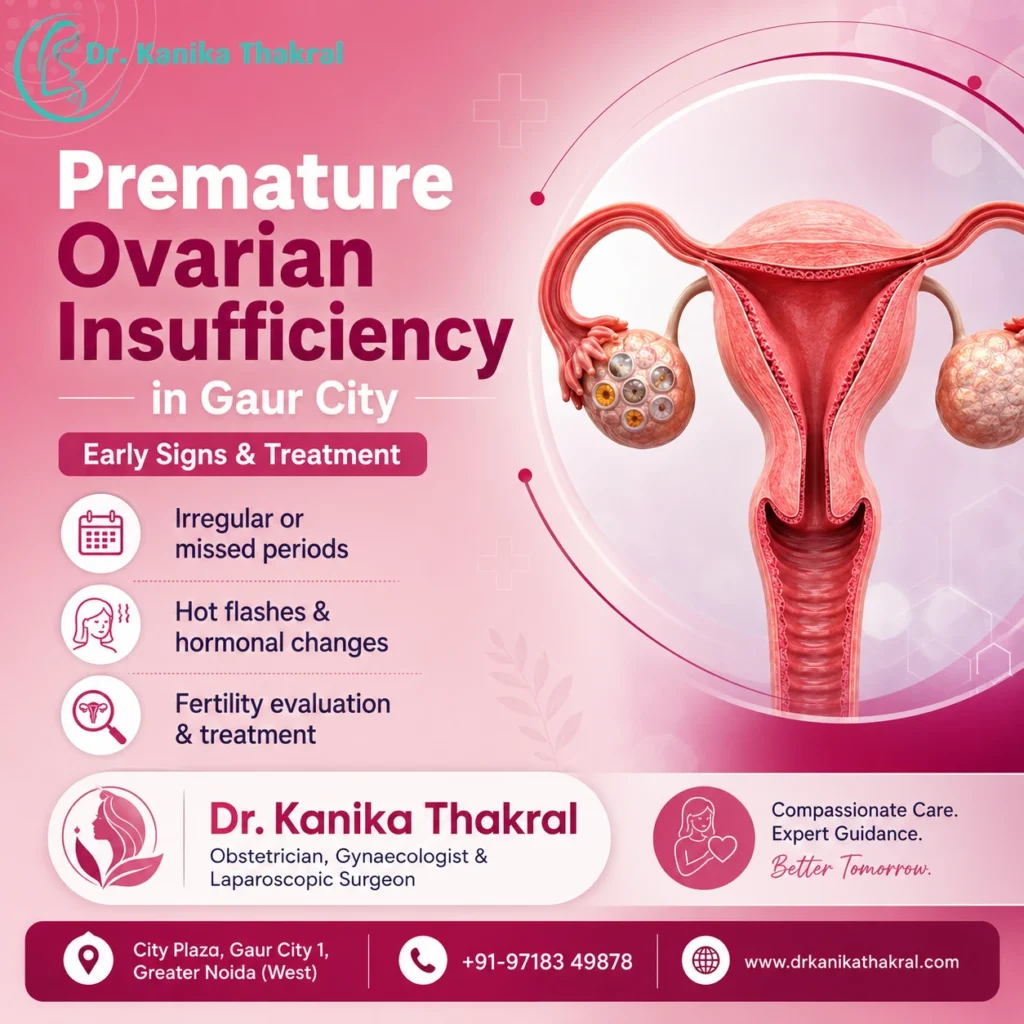
Premature Ovarian Insufficiency in Gaur City: Early Signs and Treatment
Premature Ovarian Insufficiency in Gaur City is an important women’s health topic, especially for young women who are facing missed periods, irregular periods, hot flashes, mood changes, or difficulty conceiving before the age of 40. Premature Ovarian Insufficiency, also called POI, happens when the ovaries stop working normally earlier than expected.
This does not always mean periods stop completely. Some women may still get occasional periods. Some may even ovulate sometimes. However, hormone levels may become low, and fertility may become affected.
At Dr. Kanika Thakral’s clinic, women get clear guidance for menstrual concerns, hormonal health, fertility planning, and early menopause-like symptoms. If you are searching for a trusted Gynecologist in Gaur City, timely consultation can help you understand the cause and start the right care early.
What Is Premature Ovarian Insufficiency?
Premature Ovarian Insufficiency means the ovaries are not producing normal levels of hormones before the age of 40. The ovaries may also not release eggs regularly. Because of this, periods may become irregular, delayed, or absent.
Mayo Clinic explains that primary ovarian insufficiency happens when the ovaries stop working as expected before age 40. It can cause low estrogen levels and irregular egg release.
POI is different from natural menopause. In menopause, periods stop permanently. In POI, ovarian function may be unpredictable. Some women may still get periods from time to time.
This is why a missed period or irregular cycle should not be ignored, especially when it happens repeatedly.
Early Signs of Premature Ovarian Insufficiency in Gaur City
The early signs of Premature Ovarian Insufficiency in Gaur City may look similar to other hormonal problems. That is why many women delay consultation. They may think symptoms are due to stress, weight changes, work pressure, or lifestyle.
The most common early sign is irregular or missed periods. Some women may also notice hot flashes, night sweats, disturbed sleep, mood changes, vaginal dryness, low interest in sex, or difficulty getting pregnant.
MedlinePlus notes that the first sign of primary ovarian insufficiency is usually irregular or missed periods. Later symptoms may include hot flashes, night sweats, irritability, poor concentration, reduced sex drive, painful sex, and vaginal dryness.
You should consult a gynecologist if you notice symptoms such as:
- Missed periods for several months
- Irregular periods without a clear reason
- Hot flashes or night sweats
- Sleep disturbance
- Mood swings or irritability
- Vaginal dryness
- Pain during intercourse
- Difficulty conceiving
- Sudden change in menstrual pattern
These symptoms do not always mean POI. They can also happen due to PCOS, thyroid problems, pregnancy, stress, weight changes, or other hormonal concerns. Therefore, proper evaluation is important.
Why Premature Ovarian Insufficiency Should Not Be Ignored
POI is not only a period problem. It can affect hormones, fertility, bones, heart health, emotional wellbeing, and quality of life. Low estrogen levels may increase the risk of weak bones over time. It may also affect vaginal health, sexual comfort, and mood.
ACOG explains that primary ovarian insufficiency may be linked with symptoms like hot flushes, night sweats, vaginal dryness, painful sex, and disturbed sleep. It also highlights that hormone therapy can help reduce long-term health risks in many women with POI.
Early diagnosis can make a big difference. It helps the doctor guide you about hormone support, fertility options, bone health, lifestyle care, and long-term follow-up.
If you need Irregular Periods Treatment, do not wait for symptoms to become severe. Regular or repeated missed periods need attention.
Possible Causes of Premature Ovarian Insufficiency
In many women, the exact cause of POI may not be found. This can feel frustrating, but it is common. Still, doctors may look for possible causes based on symptoms and history.
Possible causes may include genetic factors, autoimmune conditions, previous chemotherapy or radiation, ovarian surgery, infections, family history, or unknown reasons. Some women may develop POI even without any clear risk factor.
Hormonal conditions can also create similar symptoms. For example, PCOS can cause irregular periods and fertility concerns. Thyroid problems can also disturb periods. This is why testing is important before confirming POI.
At a trusted Women Clinic in Gaur City, your doctor will not assume the diagnosis. She will check your history, symptoms, periods, pregnancy possibility, and blood reports before planning treatment.
How Is Premature Ovarian Insufficiency Diagnosed?
Diagnosis usually starts with a detailed consultation. Your gynecologist will ask about your periods, symptoms, pregnancy plans, past medical history, medicines, surgeries, family history, and lifestyle.
Blood tests are very important. Your doctor may suggest tests such as FSH, LH, estradiol, AMH, thyroid profile, prolactin, pregnancy test, and other hormone tests as needed. Sometimes, tests may need to be repeated to confirm the diagnosis.
ASRM guidance notes that pregnancy should be excluded in women with absent periods, and hormonal medicines can sometimes hide irregular cycles or affect test results. Some hormonal medicines may need to be stopped before POI can be confirmed, based on medical advice.
Your doctor may also advise an ultrasound to check the uterus and ovaries. In some cases, additional tests may be needed to check autoimmune or genetic causes.
Premature Ovarian Insufficiency and Fertility
One of the biggest concerns with Premature Ovarian Insufficiency in Gaur City is fertility. Many women first discover POI when they try to conceive and face difficulty.
POI can reduce the chance of natural pregnancy because ovulation becomes irregular. However, it does not mean pregnancy is always impossible. Some women may still ovulate occasionally. Fertility options depend on age, hormone levels, ovarian reserve, and overall health.
If pregnancy is your goal, early consultation is very important. Your doctor may discuss fertility evaluation, ovulation tracking, reproductive medicine referral, and suitable options based on your case.
Good Pregnancy Care starts before conception. If you have POI or suspected POI, planning should be done carefully with medical guidance.
Treatment for Premature Ovarian Insufficiency
Treatment depends on symptoms, age, health history, fertility goals, and test results. The aim is to manage symptoms, protect long-term health, support emotional wellbeing, and guide fertility planning.
Hormone therapy is commonly used in many women with POI unless there is a medical reason to avoid it. Cleveland Clinic explains that hormone therapy can help reduce symptoms such as night sweats and vaginal dryness. It may also help lower the risk of osteoporosis and other health concerns linked to POI.
Treatment may include:
- Hormone therapy, if suitable
- Calcium and vitamin D support
- Bone health monitoring
- Lifestyle changes
- Fertility counselling
- Emotional support
- Regular gynecological follow-up
- Treatment of related conditions
Never start hormone medicines on your own. Your gynecologist will decide what is safe for you.
Lifestyle Care for POI
Lifestyle changes cannot reverse POI, but they can support overall health. They may help protect bones, improve energy, support mood, and reduce long-term health risks.
Helpful lifestyle steps may include:
- Eat a balanced diet
- Include calcium-rich foods
- Maintain vitamin D levels
- Do weight-bearing exercise
- Avoid smoking
- Limit alcohol
- Manage stress
- Sleep well
- Attend regular checkups
Bone health is very important in POI. Your doctor may advise bone density testing in selected cases. NHS Inform notes that early or premature menopause can increase the risk of osteoporosis and cardiovascular disease, and HRT may reduce these risks while also controlling symptoms.
Emotional Impact of Premature Ovarian Insufficiency
POI can affect emotional health. Some women feel shocked after diagnosis. Others feel anxious about fertility, marriage, pregnancy, or long-term health. These feelings are valid.
It is important to understand that POI is a medical condition. It is not your fault. You did not cause it by working, exercising, traveling, or being stressed.
Support matters. Talk to your doctor, partner, or trusted family member. If anxiety or sadness feels heavy, counselling can also help.
At Dr. Kanika Thakral’s clinic, women get practical guidance with a sensitive approach. The goal is to help you understand your condition and plan the next step with confidence.
POI, Pregnancy and Safe Delivery
Women with POI who are planning pregnancy need proper medical guidance. Some may conceive naturally, while others may need fertility support. Once pregnancy happens, regular antenatal care becomes important.
Pregnancy planning should include health assessment, hormone history, thyroid check, sugar check, nutrition, supplements, and early scans. With proper monitoring, many women can move toward a healthier pregnancy journey.
The aim of every pregnancy is Safe Delivery for mother and baby. Your doctor will guide you about pregnancy monitoring, risk factors, and delivery planning based on your case.
When Should You Consult a Gynecologist?
You should consult a gynecologist if your periods stop before age 40 or become irregular without a clear reason. You should also seek care if you have hot flashes, night sweats, vaginal dryness, mood changes, or difficulty conceiving.
Do not wait for months hoping the problem will settle on its own. Early testing can help find the cause. It can also prevent delay in fertility planning and long-term health care.
If you are looking for the Best Gynecologist in Gaur City, Dr. Kanika Thakral can help you with menstrual evaluation, hormone testing, fertility guidance, and POI treatment planning.
Why Choose Dr. Kanika Thakral?
Premature ovarian insufficiency needs careful diagnosis and sensitive counselling. Many symptoms overlap with PCOS, thyroid imbalance, stress, and other hormonal problems. That is why expert evaluation is important.
Dr. Kanika Thakral provides women’s health care, Irregular Periods Treatment, fertility counselling, pregnancy planning, and hormonal health support. If you need a Gynecologist in Gaur City or a reliable Women Clinic in Gaur City, you can consult Dr. Kanika Thakral for patient-friendly care.
The focus is on clear explanation, correct diagnosis, safe treatment, and long-term health support.
Final Thoughts
Premature Ovarian Insufficiency in Gaur City is a condition where the ovaries do not work normally before the age of 40. It may cause irregular periods, missed periods, hot flashes, night sweats, vaginal dryness, mood changes, and difficulty conceiving.
Early diagnosis is important because POI can affect fertility, bone health, emotional wellbeing, and long-term health. Treatment may include hormone support, lifestyle care, fertility counselling, and regular follow-up.
For POI symptoms, irregular periods, fertility concerns, Pregnancy Care, and guidance toward Safe Delivery, consult Dr. Kanika Thakral. Timely care can help you understand your health and plan your future with more confidence.
FAQs
1. What is Premature Ovarian Insufficiency?
Premature Ovarian Insufficiency is a condition where the ovaries stop working normally before the age of 40. It may cause irregular periods, missed periods, low estrogen symptoms, and fertility concerns.
2. What are the early signs of Premature Ovarian Insufficiency?
Early signs may include irregular periods, missed periods, hot flashes, night sweats, sleep problems, mood changes, vaginal dryness, and difficulty conceiving.
3. Can Premature Ovarian Insufficiency be treated?
Yes, treatment can help manage symptoms and protect long-term health. It may include hormone therapy, lifestyle care, bone health support, fertility counselling, and regular follow-up.
4. Can I get pregnant with Premature Ovarian Insufficiency?
Pregnancy may still happen in some women because ovarian activity can be unpredictable. However, fertility may be reduced, so early consultation is important.
5. Is POI the same as menopause?
No. POI is different from natural menopause. In POI, ovarian function may be irregular, and some women may still have occasional periods or ovulation.
