
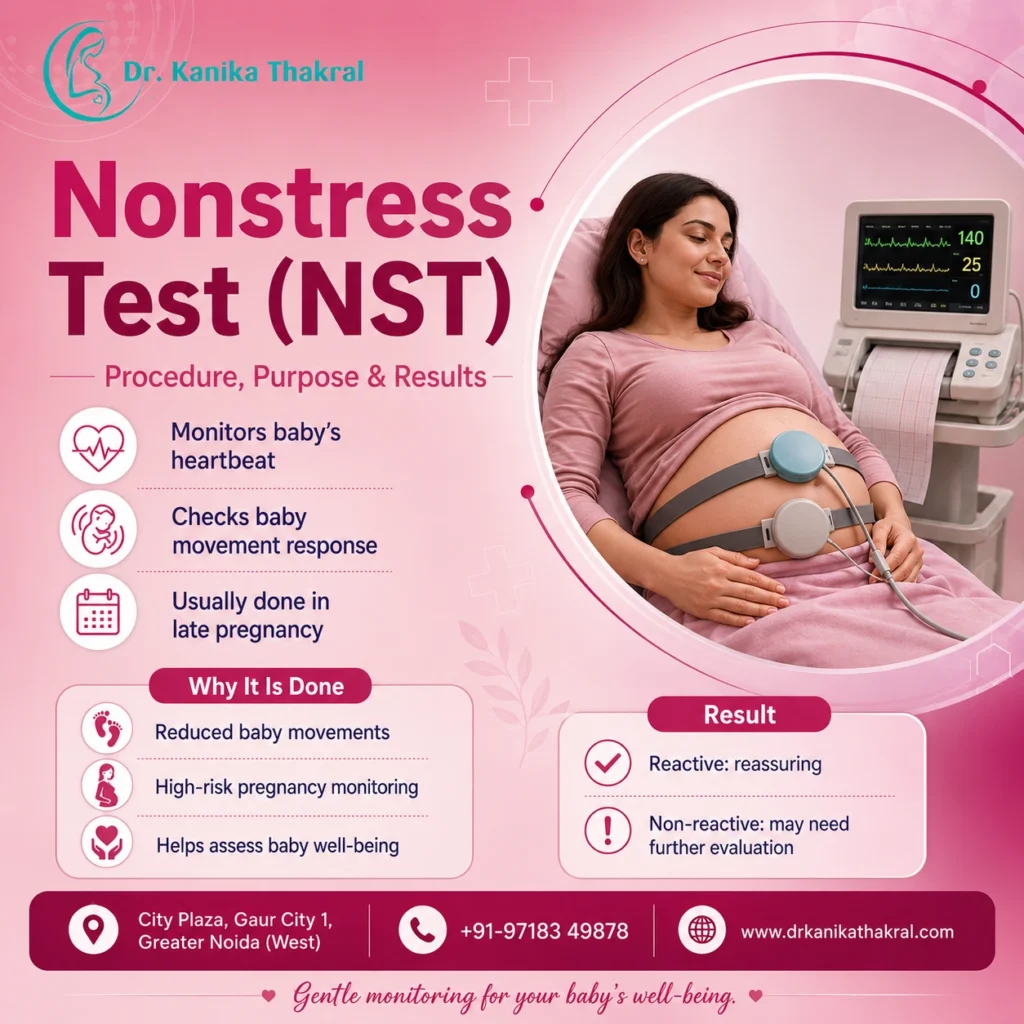
Nonstress Test (NST): Procedure, Purpose and Risks
A Nonstress Test is a simple pregnancy monitoring test. It checks the baby’s heartbeat and how the heartbeat changes when the baby moves. Doctors usually suggest this test in the later weeks of pregnancy when they want to monitor the baby more closely.
The word “nonstress” can sound serious, but the test does not put stress on the baby. It is painless, safe, and non-invasive. There are no injections, cuts, medicines, or radiation involved. MedlinePlus explains that a Nonstress Test is a safe and painless pregnancy test that measures the baby’s heart rate as the baby moves.
At Dr. Kanika Thakral’s clinic, expecting mothers get clear guidance for baby movement concerns, high-risk pregnancy care, NST report understanding, and complete Pregnancy Care. When you understand why the test is done, it becomes less stressful and easier to follow.
What Is a Nonstress Test?
A Nonstress Test is a fetal monitoring test done during pregnancy. It records the baby’s heart rate for a short period. It also checks whether the heart rate increases when the baby moves.
In a healthy pattern, the baby’s heartbeat often rises with movement. This response can give the doctor useful information about the baby’s wellbeing. The test may also record uterine tightening or contractions if needed.
This test is usually done with sensors placed on the mother’s abdomen. You do not need to be admitted for a routine NST unless your doctor has a specific reason. In most cases, it is done as a simple monitoring test.
Why Doctors Recommend a Nonstress Test
Doctors recommend a Nonstress Test when they want extra information about the baby’s condition inside the womb. It is often advised when pregnancy needs closer observation.
Your doctor may suggest NST if there is reduced baby movement, high blood pressure, diabetes, low amniotic fluid, baby growth concern, twin pregnancy, or pregnancy beyond the due date. It may also be advised if there was a previous pregnancy complication.
Common reasons for NST include:
- Reduced baby movements
- High blood pressure in pregnancy
- Diabetes during pregnancy
- Low amniotic fluid
- Baby growth concerns
- Twin or multiple pregnancy
- Pregnancy beyond due date
- Previous pregnancy complications
- High-risk pregnancy monitoring
The purpose is not to create fear. The purpose is to check the baby at the right time and plan care safely.
When Is a Nonstress Test Done?
A Nonstress Test is usually done in the third trimester. In many cases, doctors advise it after 28 weeks because baby movement and heartbeat patterns are more useful after this stage.
However, the exact timing depends on your pregnancy condition. Some mothers may need NST once. Others may need it more than once if the pregnancy is high risk or if baby movement needs regular monitoring.
If you feel reduced baby movements, do not wait at home. Contact your doctor and follow the advice given. Reduced movement should always be taken seriously, even if the previous scan was normal.
Nonstress Test Procedure: What Happens During NST?
The Nonstress Test procedure is simple. You will usually sit in a comfortable position or lie on your side. A belt with sensors is placed around your abdomen.
One sensor records the baby’s heartbeat. Another sensor may record contractions or tightening of the uterus. The machine shows the baby’s heart rate pattern on a screen or paper tracing.
The test usually takes around 20 minutes. If the baby is sleeping, it may take longer. Sometimes, the doctor may wait more time or gently try to wake the baby with safe stimulation.
During the test, you may be asked to press a button when you feel baby movement. This helps match the baby’s movement with the heartbeat pattern.
Is a Nonstress Test Painful?
No, a Nonstress Test is not painful. It is not an internal test. It does not involve a needle or any procedure inside the body.
Most mothers only feel the belts around the belly. If the belts feel tight, you can tell the staff. The position can be adjusted so you feel comfortable.
The test is also safe for the baby. It only records the heartbeat and movement response. It does not harm the pregnancy.
What Does a Reactive Nonstress Test Mean?
A reactive Nonstress Test is usually a reassuring result. It means the baby’s heart rate increased as expected during the test.
ACOG explains that if two or more heart rate accelerations happen within a 20-minute period, the NST result is considered reactive or reassuring.
A reactive result usually means the baby is doing well at that time. Still, it does not replace all pregnancy checkups. Your doctor will also consider your symptoms, scans, baby movements, fluid level, and overall pregnancy condition.
What Does a Nonreactive Nonstress Test Mean?
A nonreactive Nonstress Test means the expected heartbeat rise was not seen during the test period. This can sound worrying, but it does not always mean there is a problem.
Sometimes, the baby may simply be sleeping. In that case, your doctor may continue monitoring for more time. The test may also be repeated.
Cleveland Clinic explains that NST results are reactive or nonreactive, and a nonreactive result does not always mean there is a problem. It may only mean that more testing is needed.
So, do not panic if your report says nonreactive. Your gynecologist will read the result with the full pregnancy picture.
What Happens After a Nonreactive NST?
If the Nonstress Test is nonreactive, your doctor may suggest more monitoring. The next step depends on your pregnancy week, baby movement, scan report, fluid level, and mother’s health.
Your doctor may advise:
- Repeat NST
- Longer monitoring
- Ultrasound scan
- Doppler scan
- Biophysical profile
- Amniotic fluid check
- Closer follow-up
- Delivery planning, if needed
A biophysical profile is another test that may combine ultrasound with fetal monitoring. It helps check baby movement, breathing movement, muscle tone, fluid, and heartbeat pattern.
Is Nonstress Test Safe?
Yes, a Nonstress Test is safe. It is non-invasive and does not use radiation. It does not cause contractions and does not put pressure on the baby.
Cedars-Sinai states that there are no risks to either the mother or baby during a nonstress test. It also notes that no special preparation is usually needed.
Because NST is safe, doctors may repeat it when needed. However, it should be done only when your doctor advises it.
Are There Any Risks of Nonstress Test?
The Nonstress Test itself has no major physical risk. The main issue is emotional stress. Some mothers feel anxious while waiting for the result.
A nonreactive result may also lead to more tests. But this does not always mean the baby is in danger. It only means the doctor needs more information.
Possible concerns include:
- Anxiety during monitoring
- Longer test time if baby is sleeping
- Repeat testing if result is unclear
- Additional scan or Doppler if needed
- More visits in high-risk pregnancy
These steps are taken for safety. They help the doctor make better decisions.
Nonstress Test and Baby Movements
Baby movements are very important during pregnancy. You know your baby’s normal movement pattern better than anyone else. If movement feels less, different, or absent, contact your doctor.
A Nonstress Test may be done after reduced movement to check the baby’s heartbeat pattern. Your doctor may also check blood pressure, urine, ultrasound, fluid level, or Doppler if needed.
Do not drink something cold or sweet and wait for hours if movement is clearly reduced. It is always safer to call your doctor and follow medical advice.
Nonstress Test in High-Risk Pregnancy
A Nonstress Test is commonly used in high-risk pregnancy care. High-risk pregnancy does not mean something will definitely go wrong. It only means the mother and baby need closer monitoring.
NST may be useful if the mother has diabetes, high blood pressure, thyroid problems, twin pregnancy, low fluid, baby growth concern, or previous pregnancy complications.
If you had Fibroid Treatment, Ovarian Cyst Treatment, PCOS, fertility treatment, or repeated pregnancy concerns, share your full history with your doctor. Women with PCOS-related cycle issues may also benefit from guidance from a PCOS Specialist before and during pregnancy.
Does NST Help in Delivery Planning?
A Nonstress Test can help your doctor understand baby wellbeing. But it does not directly decide whether you will have Normal Delivery or C-section.
Delivery depends on many factors. These include baby position, placenta position, fluid level, mother’s health, previous surgery, labour progress, and baby’s condition.
If the baby is doing well and there are no other concerns, Normal Delivery may be possible. If any risk is present, your doctor will suggest the safest option. The main goal is always Safe Delivery for mother and baby.
Nonstress Test and Irregular Periods History
Some women had irregular cycles before pregnancy. This may happen due to PCOS, thyroid imbalance, stress, weight changes, or hormonal issues.
If you needed Irregular Periods Treatment before pregnancy, tell your doctor during antenatal visits. This history can help with pregnancy dating and fertility background.
Irregular periods do not mean pregnancy will always be complicated. Still, complete history helps your doctor plan better care.
How to Prepare for a Nonstress Test
You do not need major preparation for a Nonstress Test. Still, a few simple steps can make the test more comfortable.
Helpful tips include:
- Wear comfortable clothes
- Use the washroom before the test
- Carry previous pregnancy reports
- Tell your doctor about baby movements
- Eat as advised by your doctor
- Stay calm during monitoring
- Ask questions if you feel confused
Some babies are more active after the mother eats. But if you have diabetes or diet restrictions, follow your doctor’s advice.
Questions to Ask Your Doctor
It is good to ask questions during pregnancy. Clear answers help reduce fear.
You can ask:
- Why do I need a Nonstress Test?
- Is my pregnancy high risk?
- How often will I need NST?
- What does reactive mean?
- What happens if the test is nonreactive?
- Do I need Doppler or ultrasound too?
- Should I track baby movements daily?
- When should I come urgently?
Good communication helps you feel more confident during pregnancy care.
When Should You Contact Your Doctor Immediately?
Contact your doctor immediately if baby movements reduce or stop. Do not wait for the next appointment.
You should also seek care if you have bleeding, leaking fluid, severe abdominal pain, severe headache, blurred vision, swelling of face or hands, fever, dizziness, or high blood pressure symptoms.
A Nonstress Test is helpful, but timely reporting of symptoms is equally important. Early care can make a big difference.
Why Choose Dr. Kanika Thakral?
Pregnancy monitoring can feel stressful when reports are difficult to understand. Terms like NST, Doppler, BPP, and fetal monitoring can make mothers anxious.
Dr. Kanika Thakral provides patient-friendly pregnancy guidance, NST report explanation, high-risk pregnancy monitoring, and complete women’s health care. The focus is on clear communication, timely care, and safe pregnancy planning.
Whether you need pregnancy monitoring, Irregular Periods Treatment, Fibroid Treatment, Ovarian Cyst Treatment, guidance from a PCOS Specialist, or delivery planning, Dr. Kanika Thakral can guide you with care.
Final Thoughts
A Nonstress Test is a safe and simple pregnancy monitoring test. It checks the baby’s heartbeat and how it changes with movement. Doctors usually advise it in late pregnancy when they want to monitor the baby more closely.
A reactive result is usually reassuring. A nonreactive result does not always mean danger. It may only mean that the baby was sleeping or more testing is needed.
For NST guidance, high-risk pregnancy care, complete Pregnancy Care, and planning toward Safe Delivery, consult Dr. Kanika Thakral. Timely monitoring can help you feel more informed and confident.
FAQs
1. What is a Nonstress Test?
A Nonstress Test is a pregnancy monitoring test. It records the baby’s heartbeat and checks how it changes when the baby moves.
2. When is NST done in pregnancy?
NST is usually done in the third trimester, often after 28 weeks. Your doctor may advise it earlier or later depending on your pregnancy condition.
3. Is Nonstress Test painful?
No, it is not painful. It uses external sensors placed on the mother’s abdomen.
4. Is Nonstress Test safe for the baby?
Yes, it is safe. It does not use radiation, injections, or medicines. It only records the baby’s heartbeat pattern.
5. What does reactive NST mean?
Reactive NST means the baby’s heart rate increased properly during movement. It is usually a reassuring result.
