
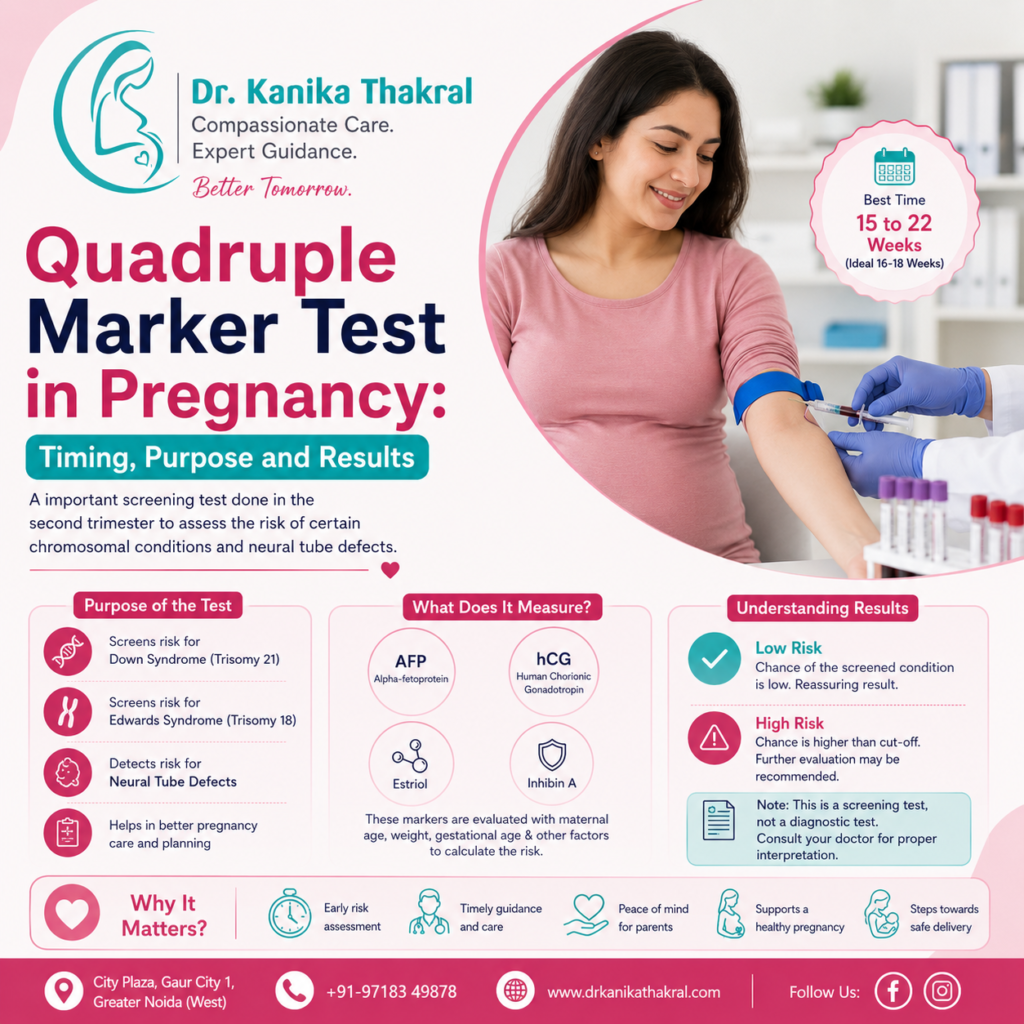
Quadruple Marker Test in Pregnancy: Timing, Purpose and Results
Quadruple Marker Test in Pregnancy is a blood screening test done during the second trimester. It helps check whether the baby has a higher chance of certain chromosomal conditions or neural tube defects. Many mothers feel worried when their doctor suggests this test, but it is important to understand that this is only a screening test. It does not confirm that the baby has a problem.
This test is usually advised when first-trimester screening was missed, when the doctor needs additional information, or when second-trimester screening is more suitable for the mother. It helps the doctor decide whether further testing or detailed counselling is needed.
At Dr. Kanika Thakral’s clinic, expecting mothers get clear pregnancy screening guidance, report explanation, and complete Pregnancy Care. If you are confused about the Quadruple Marker Test in Pregnancy, timely consultation can help you understand the test without fear.
What Is Quadruple Marker Test in Pregnancy?
The Quadruple Marker Test in Pregnancy is a maternal blood test. It measures four substances in the mother’s blood. These markers are linked with pregnancy and baby development.
The four markers are:
- AFP, also called alpha-fetoprotein
- hCG, also called human chorionic gonadotropin
- Estriol
- Inhibin A
These values are checked along with the mother’s age, pregnancy week, weight, medical history, and ultrasound details. The final report gives a risk estimate. It may show whether the pregnancy is low risk or high risk for selected conditions.
ACOG explains that second-trimester screening can include a quadruple blood test that measures four different substances in the blood and gives information about the risk of Down syndrome, trisomy 18, and open neural tube defects.
Why Is the Quadruple Marker Test Done?
The main purpose of the Quadruple Marker Test in Pregnancy is screening. It helps the doctor assess the chance of certain conditions in the baby. It is commonly used to screen for Down syndrome, Edwards syndrome, and neural tube defects.
This test is not done to create panic. It is done to understand whether the pregnancy needs closer evaluation. If the result is low risk, it can give reassurance. If the result is high risk, your doctor may suggest further counselling, detailed ultrasound, or diagnostic testing.
The test can help screen for:
- Down syndrome, also called Trisomy 21
- Edwards syndrome, also called Trisomy 18
- Open neural tube defects
- Certain pregnancy risk patterns
A high-risk report does not mean the baby definitely has a condition. It only means the chance is higher than the cut-off used by the lab. This is why the report should always be discussed with your gynecologist.
Best Time for Quadruple Marker Test in Pregnancy
Timing is very important for this test. The Quadruple Marker Test in Pregnancy is usually done in the second trimester. In many cases, it is advised between 15 and 22 weeks of pregnancy, but the best time is often around 16 to 18 weeks, depending on the doctor’s advice and lab protocol.
MedlinePlus explains that the quadruple screen test is usually done between the 15th and 22nd week of pregnancy, and it checks four substances in the blood.
Your doctor will first confirm your pregnancy week before advising the test. This may be done using your last period date and ultrasound scan. If the pregnancy week is not correct, the report may not be accurate.
Women with irregular cycles may need extra attention while calculating pregnancy age. If you had delayed periods or needed Irregular Periods Treatment before pregnancy, share this history with your doctor. Correct pregnancy dating is very important for screening tests.
Who Should Consider the Quadruple Marker Test?
Your doctor may suggest this test based on your pregnancy stage and screening needs. It may be advised if you missed first-trimester screening. It may also be suggested if your doctor wants second-trimester screening information.
The test may be especially important if:
- You missed the double marker test window
- You are in the second trimester
- You are above 35 years of age
- There is a previous history of chromosomal concern
- There is a family history of genetic disorder
- Ultrasound findings need further correlation
- Your doctor wants risk assessment for neural tube defects
However, not every pregnant woman needs the same tests. Your gynecologist will guide you based on your pregnancy week, scan report, age, and medical history.
How Is the Quadruple Marker Test Done?
The test is simple. A small blood sample is taken from the mother’s arm. The sample is then tested in the lab for the four pregnancy markers.
Usually, no special preparation is needed. Still, you should follow the instructions given by your doctor or lab. Always carry your pregnancy scan report and correct pregnancy dating details when going for the test.
The report is calculated using several factors, such as:
- Mother’s age
- Pregnancy week
- Weight
- Blood marker levels
- Single or twin pregnancy
- Diabetes status
- IVF history, if any
- Ultrasound dating
This is why you should not compare your report with someone else’s report. Every pregnancy is different. The same marker value may have a different meaning in a different pregnancy.
What Does the Quadruple Marker Test Result Mean?
The Quadruple Marker Test in Pregnancy gives a risk estimate. It may show low risk or high risk for selected conditions. Some reports also show risk in ratio form.
A low-risk result means the chance of the screened condition is low. This is usually reassuring. However, it does not guarantee that the baby has no health issue. It only means the risk is lower for the conditions screened by the test.
A high-risk result means the calculated chance is higher than the lab cut-off. This does not confirm a problem. It only means more evaluation may be needed.
ACOG clearly explains that screening tests estimate the risk of certain conditions, while diagnostic tests can give more definite information. So, a screening result should not be treated as a final diagnosis.
What If the Report Shows High Risk?
If your report shows high risk, do not panic. Many mothers become anxious after seeing words like “screen positive” or “high risk.” But this result does not mean the baby definitely has a condition.
Your doctor may review your report along with your ultrasound scan and pregnancy history. Based on the complete picture, she may suggest further steps.
These may include:
- Detailed counselling
- Level 2 ultrasound
- Repeat review of pregnancy dating
- NIPT, if suitable
- Genetic counselling
- Diagnostic testing, if needed
Diagnostic tests may include procedures like amniocentesis in selected cases. These tests are not advised to everyone. Your doctor will explain the benefits, risks, and need before suggesting anything.
Quadruple Marker Test and Ultrasound
The quadruple marker test is more useful when seen with ultrasound findings. The ultrasound helps confirm pregnancy age and checks baby development. It may also help detect structural concerns.
A wrong pregnancy week can affect the screening result. For example, if the pregnancy is actually 17 weeks but calculated as 15 weeks, the marker interpretation may change. This is why ultrasound dating is important.
A detailed anomaly scan is also an important part of second-trimester pregnancy care. It checks the baby’s body structures, growth, placenta, and fluid. Your doctor will guide you on the right timing.
Is Quadruple Marker Test Safe?
Yes, the Quadruple Marker Test in Pregnancy is safe because it is only a blood test for the mother. It does not harm the baby. There is no procedure inside the womb for this test.
The test only helps in screening. If the report shows high risk and further diagnostic testing is discussed, your doctor will explain that separately.
Many mothers feel scared because they think this test may affect the baby. That is not true. The blood test itself is simple and non-invasive.
Difference Between Double Marker and Quadruple Marker Test
Many mothers ask about the difference between double marker and quadruple marker tests. Both are pregnancy screening tests, but they are done at different stages.
The double marker test is usually done in the first trimester. It is often combined with the NT scan. The quadruple marker test is done in the second trimester and checks four markers in the mother’s blood.
In simple terms:
- Double marker test is usually for early pregnancy screening
- Quadruple marker test is usually for second-trimester screening
- Both are screening tests, not diagnostic tests
- Your doctor decides which test is suitable based on timing
If the first-trimester screening window is missed, the quadruple marker test may be discussed during the second trimester.
Can Quadruple Marker Test Help in Safe Pregnancy Care?
Yes, the test can support better pregnancy planning. It gives information that may help your doctor decide whether routine care is enough or further evaluation is needed.
However, this test is only one part of pregnancy care. It does not replace regular checkups, ultrasound scans, blood tests, nutrition, supplements, or doctor visits.
Good Pregnancy Care includes:
- Regular antenatal visits
- Timely blood tests
- Screening tests
- Ultrasound scans
- Baby growth monitoring
- Nutrition guidance
- Blood pressure and sugar monitoring
- Delivery planning
A healthy pregnancy journey depends on complete care, not only one test.
Does Quadruple Marker Test Decide Normal Delivery?
No, the quadruple marker test does not decide whether you will have Normal Delivery or C-section. It is a screening test for selected baby health risks. Delivery mode depends on other pregnancy factors.
Your doctor will decide delivery planning based on baby position, placenta position, mother’s health, previous surgery, labour progress, baby wellbeing, and pregnancy complications.
If everything is suitable, Normal Delivery may be possible. If there is any risk to mother or baby, the safest delivery option will be advised. The goal is always Safe Delivery for both mother and baby.
When Should You Consult a Gynecologist?
You should consult your gynecologist if you are in the second trimester and have not done pregnancy screening yet. You should also consult if your report shows high risk or if you are confused about the result.
Do not read the report online and make decisions yourself. Screening reports need medical interpretation. Your doctor will understand the result based on your pregnancy week, ultrasound scan, age, and health history.
You should also consult if you have:
- Previous pregnancy loss
- Previous baby with health concern
- Family history of genetic condition
- High-risk pregnancy
- Bleeding or pain
- Diabetes, thyroid, or BP issues
- Fibroids, ovarian cysts, or PCOS history
If you had Fibroid Treatment, Ovarian Cyst Treatment, or PCOS-related concerns before pregnancy, share your complete history during consultation. A PCOS Specialist can also help women with irregular cycles, fertility concerns, and pregnancy planning.
Why Choose Dr. Kanika Thakral?
Pregnancy screening reports can feel confusing. Many reports use medical terms, ratios, and risk categories that are difficult to understand. This can create fear, especially for first-time mothers.
Dr. Kanika Thakral provides clear guidance for pregnancy screening, antenatal care, report understanding, and women’s health concerns. If you are looking for pregnancy screening advice, timely consultation can help you understand the test result calmly.
Whether you need screening guidance, Irregular Periods Treatment, pregnancy planning, high-risk pregnancy care, or support for Safe Delivery, Dr. Kanika Thakral can guide you with a patient-friendly approach.
Final Thoughts
The Quadruple Marker Test in Pregnancy is an important second-trimester screening test. It checks four markers in the mother’s blood and helps assess the chance of selected chromosomal conditions and neural tube defects.
The test is usually done between 15 and 22 weeks of pregnancy. It is safe because it is only a blood test. A low-risk result can be reassuring, while a high-risk result means further evaluation may be needed.
Most importantly, the test is not a final diagnosis. It should always be interpreted by your gynecologist along with ultrasound findings and pregnancy history.
For quadruple marker test guidance, report understanding, complete Pregnancy Care, and planning toward Safe Delivery, consult Dr. Kanika Thakral.
FAQs
1. What is Quadruple Marker Test in Pregnancy?
The Quadruple Marker Test in Pregnancy is a second-trimester blood screening test. It checks four markers in the mother’s blood to assess the risk of selected chromosomal conditions and neural tube defects.
2. When is the Quadruple Marker Test done?
It is usually done between 15 and 22 weeks of pregnancy. Your doctor will guide the best timing based on your pregnancy week and scan report.
3. Is Quadruple Marker Test safe?
Yes, it is safe. It is only a blood test for the mother and does not harm the baby.
4. What does a high-risk result mean?
A high-risk result does not confirm a problem. It only means the chance is higher and further evaluation may be needed.
5. What does a low-risk result mean?
A low-risk result means the chance of the screened condition is low. However, it does not guarantee that the baby has no health concern.
