
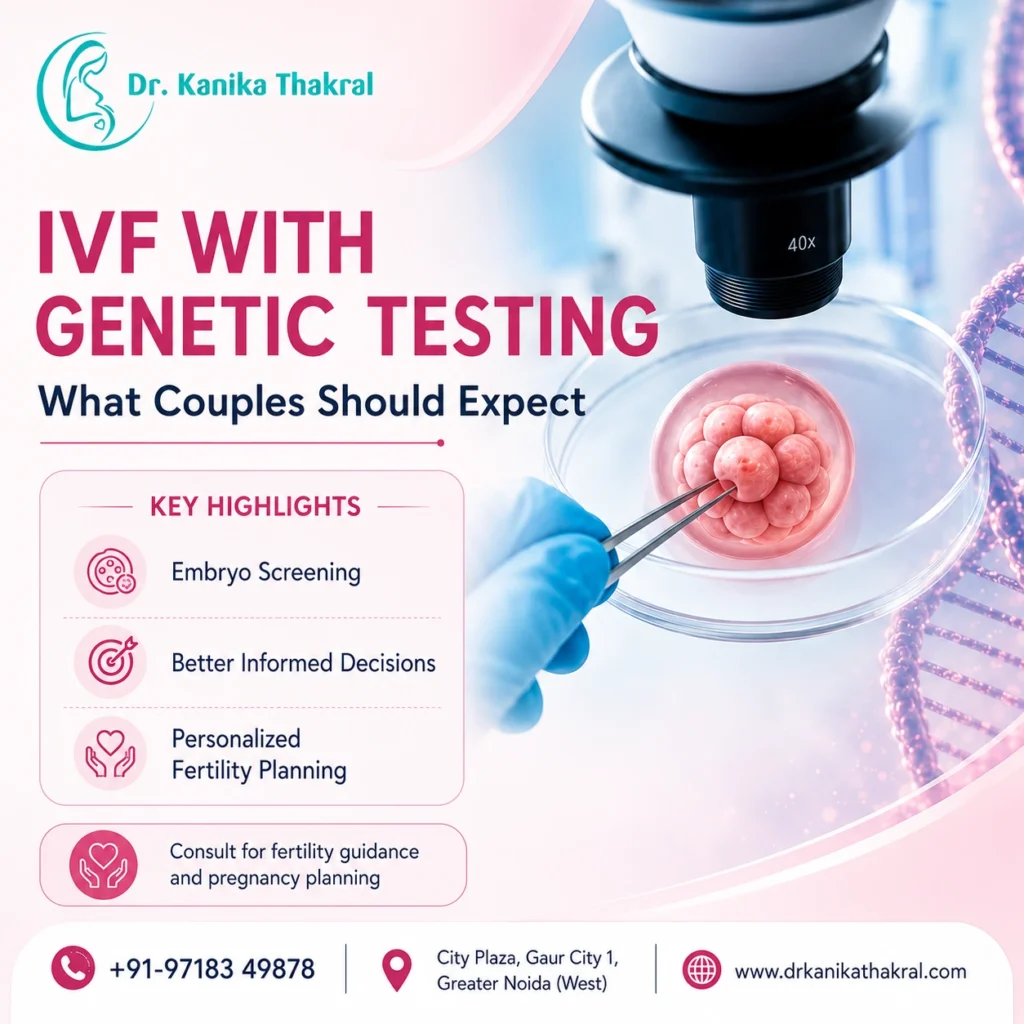
IVF with Genetic Testing: What Couples Should Expect
IVF with Genetic Testing is an advanced fertility option for couples who want more information about embryos before transfer. In this process, embryos are created through IVF, and a few cells are tested before choosing an embryo for transfer.
Many couples hear about genetic testing during IVF and feel hopeful. At the same time, they may feel confused about the process, cost, results, and limitations. This is normal. Genetic testing can be useful in selected cases, but it is not a guarantee of pregnancy.
At Dr. Kanika Thakral’s clinic, couples get clear guidance about fertility planning, pregnancy preparation, Hormonal Imbalance Treatment, Menstrual Problems, and complete women’s health care. If you are considering IVF with testing, it is important to understand what the test can and cannot tell you.
What Is IVF with Genetic Testing?
IVF with Genetic Testing means testing embryos before they are placed inside the uterus. The medical term for this is preimplantation genetic testing, or PGT.
During IVF, eggs are collected from the ovaries and fertilized with sperm in a lab. The embryos are allowed to grow for a few days. Then a small number of cells may be taken from an embryo and sent for genetic testing.
ACOG explains that preimplantation genetic testing includes genetic tests used to evaluate embryos before transfer to the uterus. It also states that PGT-A is mainly used to screen embryos for whole chromosome abnormalities.
This testing helps doctors and couples make more informed decisions. However, it does not test everything about the future baby’s health.
Why Couples Consider IVF with Genetic Testing
Couples may consider IVF with Genetic Testing for different reasons. Some want to reduce the chance of transferring an embryo with certain chromosomal problems. Some have a known genetic condition in the family. Others may have repeated miscarriages or previous IVF failures.
Your doctor may discuss genetic testing if:
- The woman is of advanced maternal age
- There is a known genetic disease in the family
- One partner is a carrier of a genetic condition
- There is a history of repeated miscarriage
- There are repeated IVF failures
- There is a chromosomal rearrangement in one partner
- The couple wants embryo screening before transfer
ASRM notes that patients may come for IVF with PGT-M because of a known genetic risk. It also says that anyone interested in PGT-M should be offered consultation with a genetic counselor.
Types of Genetic Testing in IVF
There are different types of genetic testing in IVF. Each one has a different purpose. This is why couples should not choose a test only by name.
The main types include:
- PGT-A: Screens embryos for missing or extra chromosomes.
- PGT-M: Tests embryos for a specific single-gene condition.
- PGT-SR: Tests embryos when a parent has a structural chromosome rearrangement.
ESHRE describes PGT as genetic testing of embryos created through assisted reproduction. It also notes that PGT guidance covers patient selection, counselling, embryo biopsy, testing, and follow-up.
Your fertility specialist and genetic counselor can help decide which test is suitable for your case.
What Is PGT-A?
PGT-A stands for preimplantation genetic testing for aneuploidy. It screens embryos for chromosome number problems.
Humans usually have 46 chromosomes. Sometimes, an embryo may have extra or missing chromosomes. This may reduce the chance of implantation, increase miscarriage risk, or lead to chromosomal conditions.
PGT-A helps identify embryos that appear chromosomally normal based on the test. However, it is still a screening test. It is not perfect.
ACOG states that because preimplantation genetic testing is not uniformly accurate, prenatal screening and diagnostic testing should still be offered to all patients after pregnancy, even if PGT was done.
What Is PGT-M?
PGT-M is used when there is a known single-gene disorder risk. This may include conditions that run in the family or are found through carrier screening.
For example, if both partners carry a gene change for the same recessive condition, the baby may have a higher risk of being affected. PGT-M may help test embryos for that specific condition before transfer.
Carrier screening is often part of this process. ACOG explains that carrier screening helps find out a person’s chance of having a child with a genetic disorder, and it can be done before pregnancy or during pregnancy.
PGT-M usually needs careful planning. The lab may need DNA samples from the couple and sometimes family members before the IVF cycle.
What Is PGT-SR?
PGT-SR is used when one partner has a structural chromosome rearrangement. This may include a balanced translocation or other chromosome structure concern.
A person with a balanced rearrangement may be healthy. However, embryos may have unbalanced chromosomes. This can lead to failed implantation, miscarriage, or a baby with health concerns.
PGT-SR helps identify embryos with a more balanced chromosome pattern. ESHRE notes that PGT-SR is recommended only when the method used can detect expected unbalanced forms of the chromosome rearrangement.
This test is usually advised only after proper genetic evaluation.
Step-by-Step Process of IVF with Genetic Testing
The process can feel long. But when you understand each step, it becomes easier.
The usual steps include:
- Fertility consultation and history review
- Hormone tests and ultrasound
- Ovarian stimulation injections
- Egg retrieval
- Sperm sample collection
- Fertilization in the lab
- Embryo growth for a few days
- Embryo biopsy
- Freezing of embryos
- Genetic testing report
- Embryo selection discussion
- Embryo transfer planning
Most embryos are frozen after biopsy while the genetic report is awaited. After the report, the doctor discusses which embryo may be suitable for transfer.
What Couples Should Expect Before Starting
Before starting IVF with Genetic Testing, couples should expect detailed counselling. This step is very important. It helps avoid unrealistic expectations.
Your doctor may discuss age, egg reserve, sperm quality, previous pregnancy history, previous IVF cycles, medical conditions, and genetic risks.
Women with Menstrual Problems, PCOS, thyroid concerns, or hormonal issues may need evaluation before IVF. A PCOS Specialist can help if irregular ovulation, weight gain, acne, or delayed periods are affecting fertility.
Some women may also need Hormonal Imbalance Treatment before or during fertility planning. Better preparation can support a smoother IVF journey.
Benefits of IVF with Genetic Testing
Genetic testing can offer useful information in selected cases. It may help couples and doctors make more informed choices before embryo transfer.
Possible benefits include:
- Helps identify embryos with selected genetic risks
- May reduce transfer of embryos with some chromosome problems
- Can support couples with known genetic conditions
- May reduce uncertainty in selected high-risk cases
- Helps plan embryo transfer more carefully
- May reduce emotional stress for some couples
However, benefits depend on the couple’s situation. The same test may be useful for one couple but not necessary for another.
Limitations of IVF with Genetic Testing
This part is very important. IVF with Genetic Testing does not guarantee pregnancy. It also does not guarantee a healthy baby.
The test checks selected genetic or chromosomal issues. It does not check every possible condition. Also, embryo biopsy and test interpretation have limitations.
Sometimes, results may show no embryo suitable for transfer. Sometimes, results may be unclear. In some cases, mosaic embryos may be reported. Mosaic means some cells may appear normal and some abnormal.
Because PGT is not perfect, ACOG advises that prenatal screening and diagnostic testing should still be offered during pregnancy, even after PGT.
What Do Results Mean?
The report may use terms that feel difficult. Your doctor or genetic counselor should explain each result clearly.
Common result categories may include:
- Euploid embryo
- Aneuploid embryo
- Mosaic embryo
- No result
- Affected or unaffected embryo in PGT-M
- Balanced or unbalanced result in PGT-SR
A euploid embryo means the tested cells appear to have the expected chromosome number. An aneuploid embryo means the tested cells show missing or extra chromosomes.
A “no result” may happen if the sample could not be tested properly. It does not always mean the embryo is abnormal. Your doctor will explain the next step.
Emotional Side of IVF with Genetic Testing
IVF is not only a medical journey. It is also emotional. Couples may feel hope, fear, pressure, and uncertainty at the same time.
Genetic testing can add another emotional layer. Waiting for embryo reports can be stressful. Some couples may feel upset if many embryos are abnormal or if no embryo is available for transfer.
It is important to stay prepared for different outcomes. Ask questions. Take counselling. Talk openly with your partner.
A calm and clear plan can make the journey easier.
IVF, Pregnancy Care and Delivery Planning
Once pregnancy happens after IVF, regular antenatal care is still needed. IVF with testing does not remove the need for scans, blood tests, and pregnancy monitoring.
Good Pregnancy Care includes early pregnancy confirmation, ultrasound, blood tests, screening, fetal growth monitoring, nutrition, and delivery planning.
Many couples also ask if IVF pregnancy always needs C-section. The answer is no. Delivery mode depends on pregnancy condition, baby position, placenta, mother’s health, and labour progress.
If all conditions are suitable, Normal Delivery may be possible. However, the main aim is always Safe Delivery for mother and baby.
IVF with Genetic Testing and Gynecological Conditions
Some women planning IVF may also have fibroids, ovarian cysts, PCOS, or menstrual concerns. These conditions should be reviewed before treatment.
Fibroids can sometimes affect the uterine cavity or implantation, depending on size and location. Ovarian cysts may need monitoring before stimulation. PCOS may affect ovulation and response to fertility medicines.
If needed, your doctor may discuss Fibroid Treatment, Ovarian Cyst Treatment, or PCOS care before IVF planning. The treatment plan depends on symptoms, scan findings, age, and fertility goals.
Questions Couples Should Ask
Before starting IVF with testing, couples should ask clear questions.
Helpful questions include:
- Which type of genetic testing do we need?
- Why is this test recommended for us?
- What can this test detect?
- What can this test not detect?
- Do we need genetic counselling?
- What happens if all embryos are abnormal?
- What does mosaic embryo mean?
- Will prenatal testing still be needed?
- What is the expected timeline?
- What are the possible costs?
These questions help you make informed decisions.
When Should You Consult Dr. Kanika Thakral?
You should consult Dr. Kanika Thakral if you are planning pregnancy, facing fertility concerns, or considering IVF. You should also seek guidance if you have repeated miscarriages, known genetic risk, repeated IVF failure, irregular cycles, or PCOS.
At Dr. Kanika Thakral’s clinic, couples can discuss fertility planning, women’s health evaluation, Menstrual Problems, Hormonal Imbalance Treatment, PCOS concerns, and pregnancy preparation.
The goal is to guide couples with clarity, sensitivity, and a practical plan.
Final Thoughts
IVF with Genetic Testing can be helpful for selected couples. It can give important information about embryos before transfer. It may be especially useful when there is a known genetic risk, repeated pregnancy loss, advanced maternal age, or chromosomal concern.
However, it is not a guarantee of pregnancy or a healthy baby. It also does not replace pregnancy screening and follow-up after conception.
For fertility guidance, genetic testing discussion, Pregnancy Care, and planning toward Safe Delivery, consult Dr. Kanika Thakral. The right counselling can help couples make informed and confident decisions.
FAQs
1. What is IVF with Genetic Testing?
IVF with Genetic Testing means embryos created through IVF are tested before transfer. The test checks selected genetic or chromosomal concerns.
2. Is genetic testing needed for every IVF couple?
No. It depends on age, medical history, genetic risk, previous IVF history, and doctor advice.
3. What is PGT-A?
PGT-A screens embryos for missing or extra chromosomes. It may help select embryos with a more expected chromosome number.
4. What is PGT-M?
PGT-M tests embryos for a specific single-gene condition when there is a known genetic risk in the family.
5. Can IVF with Genetic Testing guarantee pregnancy?
No. It can provide useful information, but it cannot guarantee pregnancy or a healthy baby.
