
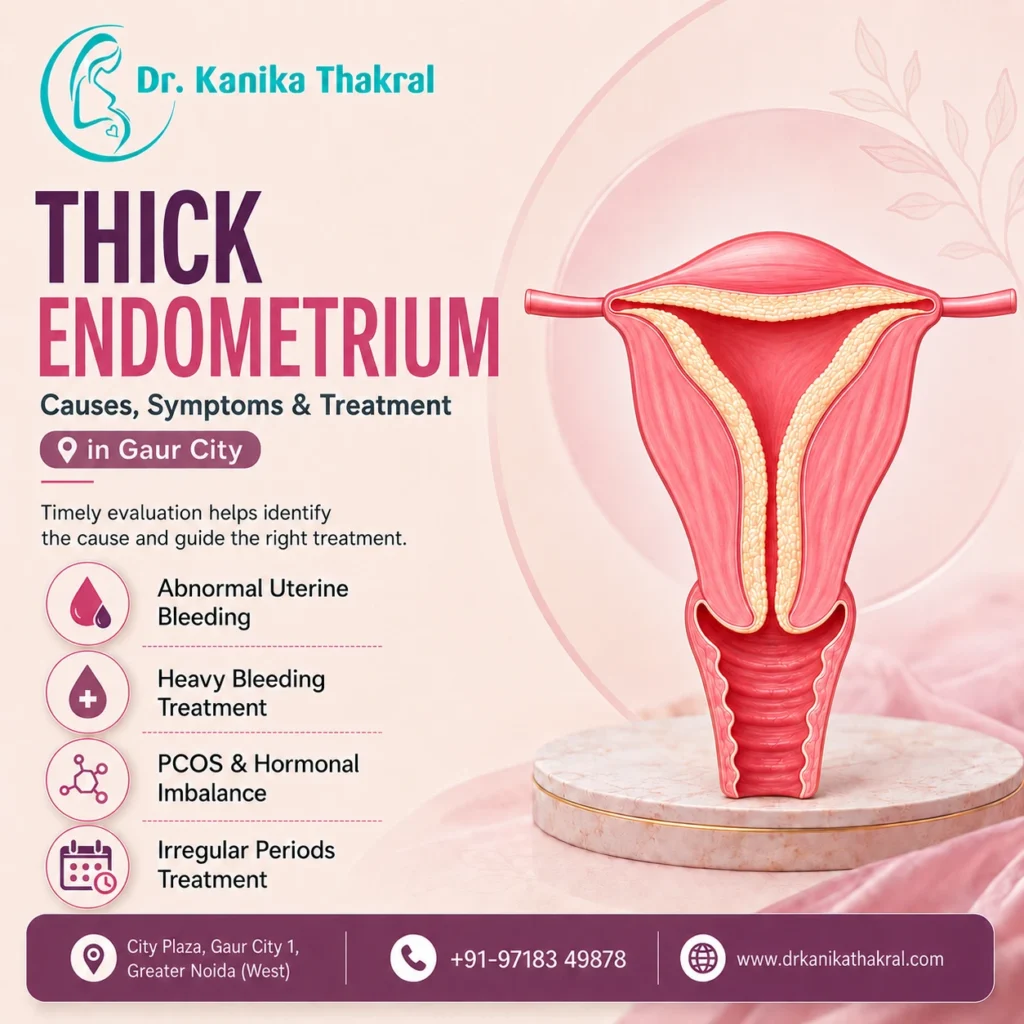
Thick Endometrium: Causes, Symptoms and Treatment in Gaur City
Thick Endometrium means the inner lining of the uterus appears thicker than expected. This lining is called the endometrium. It changes during the menstrual cycle and becomes thicker before periods. However, in some women, the lining may become unusually thick due to hormonal changes or other health concerns.
Many women first hear about this condition after an ultrasound. The report may mention increased Endometrial thickness or a thickened uterine lining. This can create worry, especially when there is heavy bleeding, irregular periods, or bleeding after menopause.
A thick lining does not always mean something serious. Still, it should be evaluated properly. Dr. Kanika Thakral provides caring guidance for Thick Endometrium in Gaur City, abnormal bleeding, period problems, hormonal concerns, and complete women’s health care.
What Is Thick Endometrium?
The endometrium is the inner lining of the uterus. It grows and sheds every month during the menstrual cycle. In the first half of the cycle, hormones help the lining grow. If pregnancy does not happen, the lining sheds as a period.
A Thick Endometrium means this lining is more thick than expected for your age, cycle day, or menopause status. In younger women, thickness can change naturally during the cycle. Therefore, ultrasound timing matters.
In women after menopause, the lining is usually thin. So, a thickened lining after menopause may need closer evaluation, especially if bleeding is present.
Why Endometrial Thickness Changes
Endometrial thickness is not the same for every woman. It changes based on age, hormones, cycle phase, pregnancy status, and medical history. During reproductive years, the lining becomes thin after periods and gradually thickens before the next period.
Sometimes, the lining becomes thick because periods are delayed. When periods do not come regularly, the lining may continue to grow under hormonal influence. This is often seen in women with PCOS, thyroid issues, obesity, or Hormonal Imbalance.
So, the number on an ultrasound report should not be judged alone. Your doctor will compare it with your age, symptoms, cycle day, and medical history.
Common Causes of Thick Endometrium
There are many possible reasons for a thickened uterine lining. Some are simple and hormone-related. Others may need further tests.
Common causes include:
- Hormonal imbalance
- Delayed or missed periods
- PCOS
- Obesity
- Thyroid problems
- Perimenopause
- Endometrial hyperplasia
- Uterine polyps
- Fibroids
- Certain hormone medicines
- Postmenopausal bleeding concerns
A thick lining may also appear during a normal menstrual cycle. This is why your doctor may ask about your last period before interpreting the scan.
Thick Endometrium and Hormonal Imbalance
Hormones control the growth and shedding of the uterine lining. Estrogen helps the lining grow. Progesterone helps balance that growth and supports proper shedding during periods.
When this balance is disturbed, the lining may become thicker. This can happen when ovulation is irregular or absent. In such cases, the lining may not shed properly every month.
Women with Hormonal Imbalance may also notice delayed periods, heavy bleeding, spotting, acne, weight changes, or mood changes. These symptoms should be discussed with a gynecologist.
Thick Endometrium and PCOS
PCOS is one of the common reasons for irregular periods. In PCOS, ovulation may not happen regularly. As a result, periods may be delayed for many weeks or months.
When periods are delayed repeatedly, the uterine lining may keep building up. Over time, this may lead to thickened endometrium, heavy periods, or unpredictable bleeding.
Women with PCOS should not ignore long gaps between periods. Regular evaluation helps protect uterine health and supports better cycle control.
Symptoms of Thick Endometrium
Some women do not have symptoms. They only find out during ultrasound. However, many women notice changes in bleeding pattern.
Common symptoms may include:
- Heavy periods
- Long periods
- Bleeding between periods
- Irregular periods
- Spotting after sex
- Bleeding after menopause
- Pelvic discomfort
- Period clots
- Weakness due to blood loss
- Repeated cycle changes
These symptoms may also happen due to fibroids, polyps, ovarian cysts, thyroid issues, or other conditions. Therefore, proper diagnosis is important.
Abnormal Uterine Bleeding
Abnormal uterine bleeding means bleeding that is different from a normal menstrual pattern. It may be too heavy, too frequent, too long, or unpredictable. It can also include bleeding between periods or bleeding after intercourse.
Women often ignore abnormal bleeding because they think it is stress or normal cycle variation. However, repeated bleeding changes should be checked. A thick uterine lining may be one possible cause.
If bleeding is heavy enough to affect daily life, you may need Heavy bleeding treatment and a full gynecological evaluation.
Heavy Bleeding and Thick Endometrium
A thickened lining may shed heavily during periods. This can cause heavy flow, clots, and long bleeding days. Some women may need to change pads very often. Others may feel weak, dizzy, or tired.
Heavy bleeding can also lead to anemia. This can reduce energy and affect daily routine. If you feel tired during periods or notice large clots, do not ignore it.
Dr. Kanika Thakral can guide you with tests, ultrasound review, and Heavy bleeding treatment based on the cause.
Thick Endometrium and Irregular Periods
Irregular periods can make the uterine lining unpredictable. Sometimes, the lining becomes too thick because it has not shed for a long time. When bleeding finally happens, it may be heavy or prolonged.
Women with Menstrual Problems should track their cycles. Note the date, flow, pain, clots, and spotting. This information helps your doctor understand the pattern.
If you need Irregular periods treatment, early consultation can help balance cycles and reduce future complications.
Thick Endometrium After Menopause
After menopause, the uterine lining is usually thin. Any bleeding after menopause should be checked. If ultrasound shows a thick lining, your doctor may advise further evaluation.
This does not always mean cancer. It may happen due to polyps, hormone effects, or other benign causes. However, postmenopausal bleeding needs proper testing to rule out serious conditions.
In many cases, your doctor may suggest an endometrial biopsy or hysteroscopy depending on symptoms and ultrasound findings.
How Is Thick Endometrium Diagnosed?
Diagnosis starts with a detailed consultation. Your doctor will ask about your age, last period date, cycle pattern, bleeding amount, pain, pregnancy history, medicines, and past medical conditions.
After that, tests may be advised based on your symptoms.
Common evaluation may include:
- Pelvic examination
- Transvaginal ultrasound
- Blood tests
- Thyroid test
- Hormonal evaluation
- Pregnancy test if needed
- Endometrial biopsy in selected cases
- Hysteroscopy if required
Not every woman needs every test. The plan depends on age, symptoms, and ultrasound findings.
Role of Ultrasound
Ultrasound is usually the first test used to check the uterus and ovaries. It can measure Endometrial thickness and also check for fibroids, polyps, ovarian cysts, or other pelvic findings.
A transvaginal ultrasound may give a clearer view of the uterine lining. However, ultrasound cannot always confirm the exact cause. Sometimes, the doctor may need tissue testing.
This is why your report should always be discussed with a Gynecologist in Gaur City, not interpreted alone.
When Is Endometrial Biopsy Needed?
An endometrial biopsy may be advised when the doctor wants to check the lining more closely. It is often suggested when there is abnormal bleeding, postmenopausal bleeding, or a thick lining that needs further testing.
During biopsy, a small sample from the uterine lining is taken and sent to a lab. The report can help detect hormonal changes, hyperplasia, infection, or abnormal cells.
The procedure may sound stressful, but it is usually short. Your doctor will explain preparation and aftercare before the test.
Thick Endometrium Treatment
Thick endometrium treatment depends on the cause. The same treatment does not work for every woman. Your doctor will decide based on age, symptoms, fertility plans, bleeding pattern, ultrasound findings, and biopsy report if done.
Treatment may include:
- Observation and repeat scan
- Medicines to regulate bleeding
- Hormonal treatment
- Treatment for PCOS
- Thyroid or hormone correction
- Iron treatment for anemia
- Polyp removal if present
- Hysteroscopy in selected cases
- Surgery in rare or severe cases
The main goal is to treat the cause, control bleeding, and protect the uterine lining.
Treatment for Hormonal Causes
If the lining is thick due to hormonal imbalance, medicines may help regulate cycles and support proper shedding of the lining. Treatment may include progesterone-based medicines or other hormonal options in selected cases.
Women with PCOS may also need weight management guidance, cycle regulation, insulin resistance evaluation, and long-term follow-up.
Do not take hormonal medicines on your own. The wrong medicine can disturb bleeding further.
Treatment for Polyps or Fibroids
If ultrasound suggests a polyp or fibroid, treatment may be different. Polyps may need removal, especially if they cause bleeding. Fibroid treatment depends on size, location, symptoms, and fertility plans.
Sometimes, fibroids and thickened endometrium may both be present. In such cases, proper diagnosis helps decide the best treatment order.
Your doctor will explain whether medicine, hysteroscopy, or another procedure is needed.
Lifestyle Support for Better Hormonal Health
Lifestyle changes cannot replace medical treatment. However, they can support hormonal balance and cycle health.
Helpful steps include:
- Maintain a healthy weight.
- Eat balanced meals.
- Reduce excess sugar.
- Stay physically active.
- Sleep well.
- Manage stress.
- Track your periods.
- Do not ignore missed periods.
- Follow up as advised.
These habits are especially helpful for women with PCOS or hormonal imbalance.
When Should You See a Doctor?
You should consult a gynecologist if you have heavy bleeding, irregular periods, bleeding after menopause, or repeated spotting. Early care helps find the cause before symptoms become worse.
Visit Dr. Kanika Thakral if you notice:
- Heavy bleeding
- Bleeding with clots
- Irregular periods
- Long gaps between periods
- Bleeding after menopause
- Pelvic pain
- Weakness during periods
- Thick endometrium on ultrasound
- Repeated abnormal bleeding
Timely evaluation helps you get the right treatment plan.
Why Choose Dr. Kanika Thakral?
Dr. Kanika Thakral provides caring support for Thick Endometrium in Gaur City, Thick endometrium treatment, abnormal bleeding, PCOS-related cycle concerns, and Irregular periods treatment.
Women can consult her for Menstrual Problems, Hormonal Imbalance, Heavy bleeding treatment, ultrasound report review, and complete gynecology care.
If you need a trusted Gynecologist in Gaur City, Dr. Kanika Thakral offers patient-friendly guidance with clear diagnosis and personalized treatment.
Final Thoughts
Thick Endometrium can happen due to normal cycle changes, delayed periods, PCOS, hormonal imbalance, polyps, fibroids, or postmenopausal changes. It is not always serious, but it should be checked when symptoms are present.
If you have heavy periods, irregular bleeding, thick endometrium on ultrasound, or bleeding after menopause, do not delay consultation.
For Thick Endometrium in Gaur City, Abnormal uterine bleeding, Heavy bleeding treatment, PCOS, and Irregular periods treatment, consult Dr. Kanika Thakral. Early diagnosis can bring clarity, better treatment, and peace of mind.
FAQs
1. What is Thick Endometrium?
Thick Endometrium means the inner lining of the uterus is thicker than expected for your age, cycle day, or menopause status.
2. Is thick endometrium serious?
It is not always serious. However, it needs evaluation if there is abnormal bleeding, heavy periods, irregular cycles, or bleeding after menopause.
3. What causes thick endometrium?
Common causes include hormonal imbalance, PCOS, delayed periods, polyps, fibroids, obesity, thyroid issues, and menopause-related changes.
4. Can PCOS cause thick endometrium?
Yes. PCOS can cause irregular ovulation and delayed periods. This may lead to thickening of the uterine lining in some women.
5. What are the symptoms?
Symptoms may include heavy bleeding, long periods, irregular periods, spotting, pelvic discomfort, clots, or bleeding after menopause.
6. How is endometrial thickness checked?
Endometrial thickness is usually checked with ultrasound, often transvaginal ultrasound for better clarity.
