
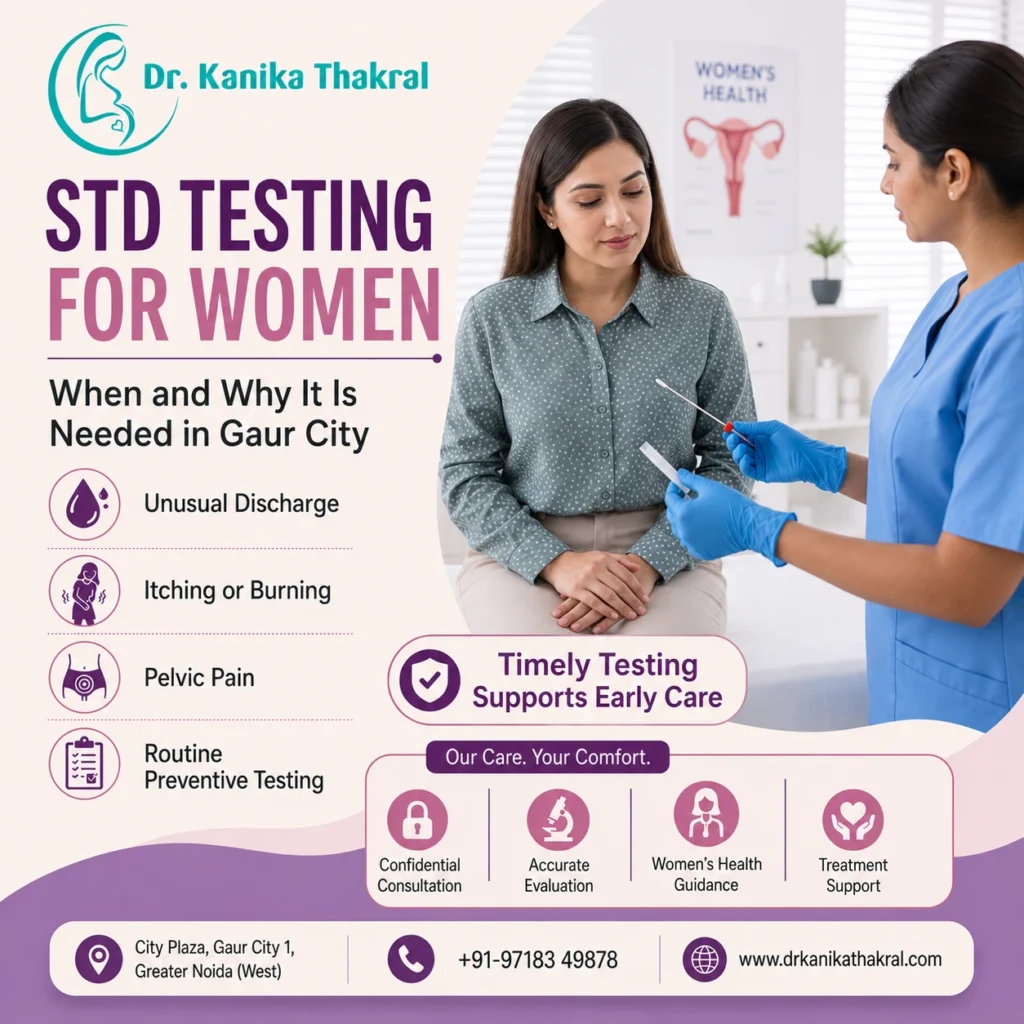
STD Testing for Women in Gaur City: When and Why It Is Needed
STD Testing for Women is an important part of women’s health. Many sexually transmitted infections do not show clear symptoms in the beginning. Because of this, a woman may have an infection without knowing it.
Some women may notice discharge, burning while passing urine, pelvic pain, itching, or pain during intercourse. However, symptoms can be mild or confusing. Therefore, testing helps find the real cause and guides the right treatment.
Timely testing can protect reproductive health. It can also reduce the risk of complications and help prevent infection from spreading to a partner. Dr. Kanika Thakral provides guidance for STD Testing for Women in Gaur City, infection evaluation, cervical screening awareness, and complete women’s health support.
What Is STD Testing for Women?
STD Testing for Women means checking for infections that can spread through sexual contact. These infections are also called STIs. Some infections may affect the vagina, cervix, uterus, fallopian tubes, or overall health.
Testing may include a urine sample, blood test, swab test, or examination. The right test depends on symptoms, exposure history, age, pregnancy status, and overall health.
Common infections checked during testing may include chlamydia, gonorrhea, syphilis, HIV, hepatitis, trichomoniasis, herpes when symptoms are present, and HPV-related concerns in selected cases.
Not every woman needs every test. Therefore, consultation helps decide the correct screening plan.
Why STD Testing Is Important
Many STIs are treatable when detected early. However, untreated infections can create long-term problems. Some infections may move upward and affect the uterus or fallopian tubes. As a result, they may cause pelvic pain, fertility problems, or pregnancy-related concerns.
Early testing also helps avoid repeated infection. In many cases, partner testing or treatment may also be needed. Otherwise, the same infection may come back again.
Moreover, testing reduces confusion. Many symptoms of STIs look similar to common vaginal infections. So, testing helps avoid wrong medicines and delayed care.
When Should Women Get Tested?
Women should consider testing when symptoms appear, after possible exposure, during pregnancy when advised, or during a routine sexual health evaluation.
Testing may be useful if you have:
- A new sexual partner
- More than one partner
- A partner with STI symptoms
- Unprotected sex
- Unusual vaginal discharge
- Burning urination
- Pelvic pain
- Itching in private parts
- Pain during intercourse
- Bleeding after intercourse
- Repeated vaginal infections
- Pregnancy planning
- Past history of STI
Even when symptoms are absent, testing may still be needed based on risk. Therefore, it is better to discuss your history honestly with Dr. Kanika Thakral.
Common Symptoms That Need Attention
STI symptoms are not always obvious. Some women feel completely normal. Others may notice symptoms that come and go.
Common symptoms include unusual discharge, smell, itching, burning, pelvic pain, lower abdominal pain, sores, blisters, pain during intercourse, or bleeding between periods. Sometimes, symptoms may appear after sex. In other cases, they may develop slowly.
These symptoms can happen due to STIs, fungal infection, bacterial imbalance, urinary infection, skin irritation, or hormonal changes. Because symptoms overlap, self-treatment is not a safe option.
A proper STD test for women can help find the actual cause.
Why Symptoms Can Be Confusing
Many women think itching or discharge always means a simple infection. However, that is not always true. Different infections can cause similar symptoms. Also, some non-infectious conditions can cause burning, itching, or discomfort.
For example, Itching in private parts may happen due to sweating, tight clothing, allergy, diabetes, fungal infection, STI, or a vulvar skin condition. Similarly, discharge may be due to infection, hormonal changes, or cervical irritation.
That is why Vaginal infection treatment should be based on evaluation. Random creams or tablets may reduce symptoms for a short time, but they may not treat the real problem.
STI Screening for Women Without Symptoms
STI screening for women can be important even when there are no symptoms. Some infections stay silent for a long time. During this time, they may still affect reproductive health.
Silent infections are risky because they may go untreated. Over time, they can lead to pelvic infection, pain, or fertility concerns in some women.
Screening is especially helpful after unprotected sex, a new partner, or a partner’s infection diagnosis. It is also useful before pregnancy planning when advised.
STD Testing Before Pregnancy
Testing before pregnancy can help support safer planning. Some infections can affect pregnancy if they are not treated early. Therefore, women planning pregnancy should discuss infection screening with Dr. Kanika Thakral.
If an infection is found, treatment can be started before conception or early in pregnancy. This helps reduce risks and gives better clarity before planning the next step.
Pre-pregnancy testing is not something to feel shy about. It is a responsible health step.
STD Testing During Pregnancy
Pregnancy is an important time for infection screening. Some infections can affect the mother, pregnancy, or baby if not detected and treated on time.
During pregnancy, the recommended tests depend on age, symptoms, risk factors, and medical history. Some tests may be advised early in pregnancy. Others may be repeated later if risk continues.
Testing during pregnancy supports safer care. It also helps plan timely treatment when needed.
What Tests Are Done?
The type of test depends on the suspected infection and symptoms. Dr. Kanika Thakral may suggest one or more tests after discussion.
Common testing methods include:
- Urine test
- Blood test
- Vaginal swab
- Cervical swab
- Physical examination
- Pap Smear Test when needed
- HPV-related testing in selected cases
Some results may come quickly. Others may take longer. Once the report is available, treatment is planned according to the result.
Pap Smear Test and STD Testing
A Pap Smear Test is different from an STD test. Pap smear checks cervical cells for changes that may need follow-up. It is mainly used for cervical health screening.
STD tests check infections. So, a normal Pap smear does not mean all STI tests are normal. Similarly, STD testing does not replace cervical screening.
However, both are important for women’s health. During a Women’s Health Checkup, Dr. Kanika Thakral may guide whether you need Pap smear, STI screening, HPV-related guidance, or infection testing.
HPV Vaccine and Women’s Health
The HPV Vaccine helps protect against certain HPV types linked with cervical disease and genital warts. It works best before exposure to HPV. However, eligible women should discuss vaccination with Dr. Kanika Thakral.
Vaccination does not replace cervical screening. Even after vaccination, women may still need Pap smear or HPV-related screening as advised.
So, prevention and screening should work together. This combination helps protect long-term cervical and reproductive health.
STD Testing and Vaginal Infection Treatment
Many women visit for itching, discharge, smell, or burning. These symptoms may seem like a regular vaginal infection. However, some STIs can also cause similar complaints.
For this reason, Vaginal infection treatment should not be based only on guesswork. The right approach may include examination, swab test, urine test, or STI screening.
Once the cause is clear, treatment becomes more accurate. Also, repeated infections can be managed better when the underlying reason is found.
Why Partner Testing May Be Needed
If one partner has an STI, the other partner may also need testing or treatment. Treating only one person can lead to reinfection.
This discussion may feel uncomfortable. However, it is important for both partners. Honest communication and timely testing can prevent repeated infection.
Dr. Kanika Thakral can guide what steps are needed based on the infection type and report.
Treatment After STD Test
Treatment depends on the infection. Some STIs are treated with antibiotics. Others may need antiviral medicines, longer monitoring, or follow-up testing.
It is important to complete the full medicine course. Also, avoid sexual contact until your doctor says it is safe. If partner treatment is advised, it should not be skipped.
Follow-up may be needed in some cases. This helps confirm recovery and reduce the chance of repeat infection.
How to Reduce STI Risk
Prevention is an important part of women’s health. While no method gives complete protection except avoiding exposure, safer habits can reduce risk.
Helpful steps include:
- Use condoms correctly.
- Avoid unprotected sex.
- Discuss testing with your partner.
- Avoid multiple high-risk exposures.
- Get tested after possible exposure.
- Do not ignore itching or discharge.
- Complete treatment fully.
- Follow partner treatment advice.
- Consider HPV Vaccine guidance.
- Continue Pap Smear Test as advised.
Small preventive steps can protect long-term reproductive health.
Myths About STD Testing for Women
Many women avoid testing because of fear or shame. However, testing is a normal health step. It should never be seen as a judgment.
One common myth is that testing is needed only when symptoms appear. This is not true because many infections can be silent.
Another myth is that married women never need testing. However, testing depends on symptoms, risk, pregnancy status, and medical advice.
Some women also think Pap smear checks all STDs. This is not correct. Pap smear and STI testing have different purposes.
When Should You Consult Dr. Kanika Thakral?
You should seek guidance if you have symptoms, exposure risk, pregnancy planning needs, or repeated vaginal infections. Early testing can prevent delay and reduce complications.
Consult Dr. Kanika Thakral if you have:
- Unusual discharge
- Burning urination
- Itching in private parts
- Pelvic pain
- Pain during intercourse
- Bleeding after sex
- New sexual partner
- Partner with STI symptoms
- Recurrent vaginal infection
- Need for Pap Smear Test
- Need for HPV Vaccine guidance
- Need for Women’s Health Checkup
Timely consultation gives clarity and peace of mind.
Why Choose Dr. Kanika Thakral?
Dr. Kanika Thakral provides caring guidance for STD Testing for Women in Gaur City, STD test for women, STI screening for women, vaginal infections, itching, Pap smear guidance, HPV vaccine advice, and women’s health support.
The approach is simple and patient-focused. First, symptoms and history are reviewed. Next, suitable tests are advised. After that, treatment is planned according to the reports.
If you are looking for a Gynecologist in Gaur City, Dr. Kanika Thakral can guide you with privacy, comfort, and clear communication.
Final Thoughts
STD Testing for Women is an important step for reproductive and overall health. Many infections may not show symptoms in the beginning. However, they can still affect fertility, pregnancy, and long-term wellbeing if ignored.
Testing is useful when symptoms appear, after possible exposure, before pregnancy, during pregnancy when advised, or as part of a Women’s Health Checkup. It also helps guide correct treatment for vaginal infection-like symptoms.
For STD Testing for Women in Gaur City, STI screening for women, Vaginal infection treatment, Pap Smear Test, HPV Vaccine guidance, and complete women’s health support, consult Dr. Kanika Thakral.
FAQs
1. What is STD Testing for Women?
STD Testing for Women means checking for sexually transmitted infections through urine tests, blood tests, swabs, or examination when needed.
2. When should a woman get an STD test?
A woman should consider testing after unprotected sex, a new partner, STI exposure, symptoms, pregnancy, or as advised during a health checkup.
3. What symptoms may need STI screening?
Symptoms may include discharge, burning urination, itching in private parts, pelvic pain, pain during intercourse, sores, or bleeding after sex.
4. Is a Pap Smear Test the same as an STD test?
No. A Pap Smear Test checks cervical cell changes. STD tests check infections like chlamydia, gonorrhea, syphilis, HIV, and others.
5. Can STIs happen without symptoms?
Yes. Many STIs can be silent. That is why testing may be needed even when there are no symptoms.
6. Is STD testing needed during pregnancy?
Yes, some STI tests may be advised during pregnancy because infections can affect mother and baby if untreated.
