
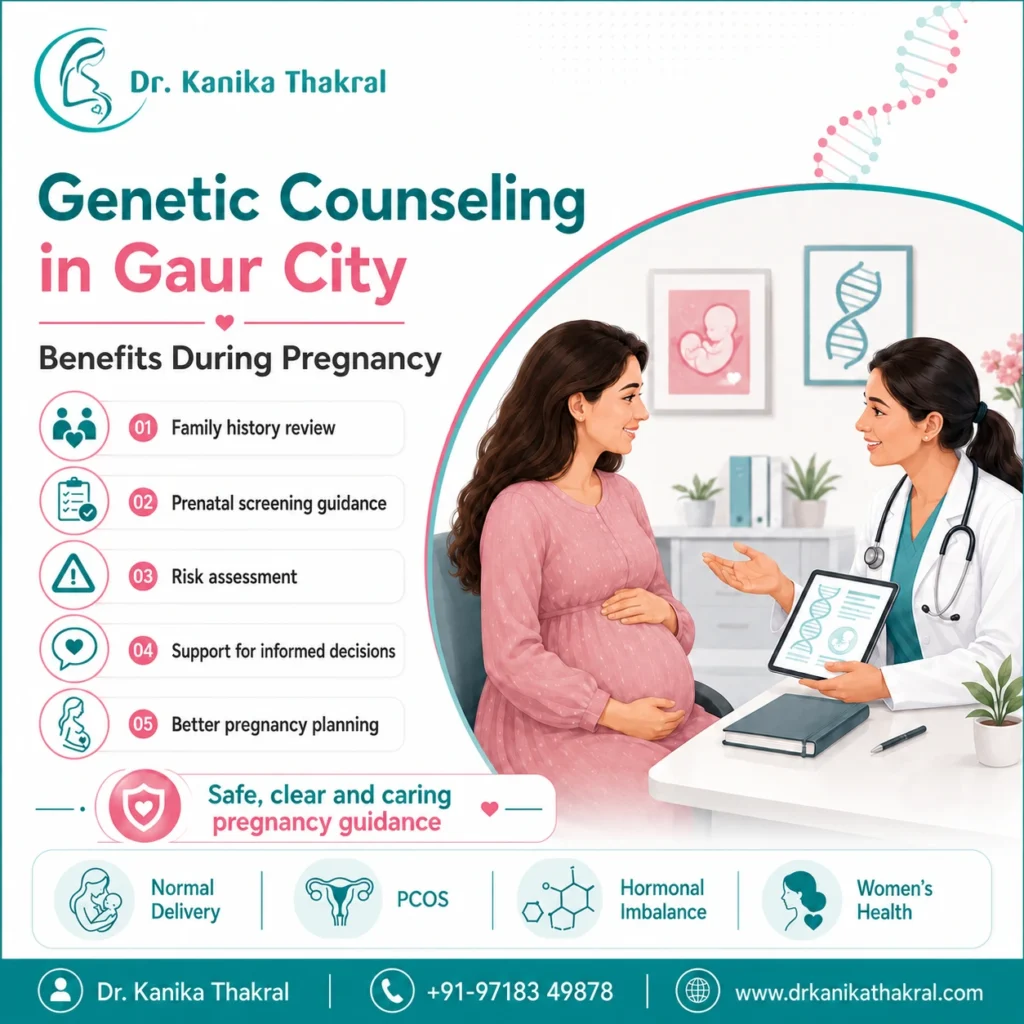
Genetic Counseling in Gaur City – Benefits During Pregnancy
Genetic Counseling helps parents understand pregnancy risks in a clear way. It explains family history, prenatal tests, and possible genetic concerns. As a result, parents can make better decisions during pregnancy.
Pregnancy is a happy journey. Still, it can also bring many doubts. Parents often worry about the baby’s growth and health. Therefore, early guidance becomes important.
At Dr. Kanika Thakral, expecting mothers get caring and simple pregnancy guidance in Gaur City. The focus is on safe care, clear advice, and confident decision-making.
What Is Genetic Counseling?
Genetic Counseling is a medical guidance process. It helps couples understand the chance of genetic or chromosomal conditions in the baby.
It does not mean that something is wrong. Instead, it helps parents understand their options.
During the visit, the doctor may ask about your health history. Your pregnancy history is also important. In addition, your family history and your partner’s family history may be discussed.
After that, your doctor may suggest the right screening or testing options.
The main goal is simple. Parents should understand the pregnancy better. They should also know what each test can and cannot tell.
Why Genetic Counseling Matters During Pregnancy
Some conditions can pass from parents to children. Some conditions can also happen without family history. So, testing and counseling can be helpful.
Genetic Counseling helps parents understand possible risks early. It also explains reports in simple words.
Many pregnancy reports can feel confusing. Words like “high risk” or “screen positive” can create fear. However, these words do not always mean that the baby has a problem.
That is why counseling is useful. It explains the meaning of the report. Also, it helps parents choose the next step calmly.
Who Should Consider Genetic Counseling?
Any pregnant woman can ask for genetic guidance. However, some women may need it more.
You should consider it if:
- You are 35 years or older
- You have a family history of genetic disease
- You had repeated miscarriages
- Your previous baby had a birth defect
- Your screening test shows high risk
- Your ultrasound report shows concern
- You and your partner are close relatives
- You have a known inherited condition
- You are planning pregnancy after fertility treatment
- You want to understand prenatal testing options
Even without these risk factors, counseling can still help. It gives peace of mind. Also, it helps parents understand pregnancy tests better.
Genetic Counseling Before Pregnancy
Genetic guidance can also be done before pregnancy. This is called preconception counseling.
It is useful for couples who want to plan a healthy pregnancy. It is also helpful when there is a family history of inherited disease.
For example, some families may have blood disorders. Some may have birth defects or repeated pregnancy loss. In such cases, early advice can help.
Women with PCOS, thyroid problems, diabetes, or Hormonal Imbalance may also need pregnancy planning. These concerns may affect ovulation, periods, and pregnancy health.
Dr. Kanika Thakral provides complete women’s health support. This includes pre-pregnancy care, cycle care, and pregnancy guidance.
Genetic Counseling During Pregnancy
During pregnancy, counseling may be advised after a blood test or ultrasound. It may also be suggested when the mother’s age is higher.
The doctor explains the report in simple language. This is very important.
For example, a screening test may show high risk. But high risk does not always confirm a disease. It only means that further evaluation may be needed.
Therefore, parents should not panic after seeing a report. They should speak to a qualified gynecologist and understand the result properly.
Tests Discussed During Genetic Counseling
There are many prenatal tests. Some tests check risk. Some tests confirm a condition.
Your doctor will suggest tests based on your case. Not every woman needs every test.
1. Screening Tests
Screening tests estimate the chance of certain conditions. These tests do not confirm a disease.
They only show whether more evaluation is needed. Therefore, a high-risk screening result should be discussed with your doctor.
2. NIPT
NIPT means Non-Invasive Prenatal Testing. It is a blood test. It checks small parts of the baby’s DNA present in the mother’s blood.
This test is usually done after 10 weeks of pregnancy.
NIPT can screen for some chromosomal conditions. However, it is still a screening test. So, a high-risk result may need confirmation.
3. Ultrasound Screening
Ultrasound helps check the baby’s growth and structure. It also helps monitor pregnancy progress.
Sometimes, ultrasound may show a marker. In that case, your doctor may suggest more tests or counseling.
4. Diagnostic Tests
Diagnostic tests can confirm some genetic conditions. These may include CVS or amniocentesis.
These tests are not advised for everyone. They are suggested only when needed. Your doctor will explain the benefits and risks before planning them.
Benefits of Genetic Counseling During Pregnancy
1. It Helps Parents Understand Risk
Family history can give useful clues. Some parents may carry a condition without any symptoms.
Genetic guidance helps identify such risks. It also explains what they may mean for the baby.
As a result, parents feel more informed.
2. It Helps Choose the Right Test
Pregnancy testing can feel confusing. There are many options. However, every test is not needed for every woman.
Counseling helps you choose the right test. It also explains the limits of each test.
This avoids unnecessary fear and confusion.
3. It Reduces Stress After Reports
A high-risk report can make parents anxious. But it may not always mean a confirmed problem.
Your doctor can explain the report clearly. Then, you can understand whether more testing is needed.
This makes the pregnancy journey less stressful.
4. It Supports Early Planning
If a risk is found, early planning helps. Your doctor may suggest closer monitoring or specialist advice.
This can help the medical team prepare better. It can also help parents understand future care needs.
5. It Helps Parents Make Informed Choices
Counseling does not force any decision. It only gives clear information.
Parents learn about the benefits, limits, and risks of tests. After that, they can make their own decision.
This makes the process respectful and supportive.
6. It Gives Emotional Support
Pregnancy is an emotional time. Test results can create worry.
A counseling visit gives parents a safe space to ask questions. It also gives emotional support during an uncertain time.
Genetic Counseling and Normal Delivery
Many women ask if genetic guidance affects Normal Delivery. In most cases, it does not decide the delivery method.
Delivery depends on many factors. These include the mother’s health, baby’s position, baby’s growth, placenta position, and pregnancy progress.
However, genetic guidance can help doctors plan better care. If the baby may need special care after birth, the medical team can prepare early.
Dr. Kanika Thakral guides women with pregnancy monitoring and delivery planning. The aim is safe care for both mother and baby.
Women’s Health Before Pregnancy
A healthy pregnancy often begins before conception. Therefore, women should not ignore existing gynecological concerns.
Some women have irregular cycles. Some have PCOS. Others may have Hormonal Imbalance or Menstrual Problems.
These concerns can affect pregnancy planning. So, early evaluation is useful.
In some cases, fibroids or ovarian cysts may also need attention. Dr. Kanika Thakral provides guidance for Fibroid Treatment and Ovarian Cyst Treatment when needed.
Good women’s health care before pregnancy can support a smoother journey.
Genetic Counseling After Pregnancy Loss
A miscarriage can be painful. Repeated pregnancy loss can be even more stressful.
In some cases, genetic reasons may play a role. However, not every miscarriage is due to genetics.
There can be many causes. These may include hormonal issues, uterine concerns, infections, or unknown reasons.
Genetic guidance may help in selected cases. It can show whether genetic testing is needed. It can also help couples plan the next pregnancy with better care.
Family History and Pregnancy Risk
Family history is very important during pregnancy planning. You should tell your doctor about any serious condition in your family.
Share details if there is a history of:
- Birth defects
- Genetic disorders
- Blood disorders
- Repeated miscarriages
- Newborn death
- Intellectual disability
- Muscle disorders
- Chromosomal conditions
Also share your partner’s family history. Both sides matter.
Even small details can help your doctor understand the risk better.
What Happens During a Counseling Visit?
A counseling visit is usually simple. It is mostly a discussion.
Your doctor may ask about:
- Your age
- Pregnancy weeks
- Previous pregnancies
- Miscarriage history
- Family history
- Existing health problems
- Previous test reports
- Ultrasound findings
- Current symptoms
After this, your doctor may explain the next step. You can also ask your doubts.
The aim is to make you feel clear, calm, and informed.
Questions to Ask Your Doctor
Before choosing any test, ask simple questions. This helps you understand your options.
You can ask:
- Why do I need this test?
- Is it a screening test or diagnostic test?
- When should I do it?
- What does a high-risk result mean?
- What does a low-risk result mean?
- Will I need another test?
- Is there any risk to the baby?
- How long will the report take?
- What should I do after the result?
These questions can help you make confident choices.
Myths About Genetic Counseling
Myth 1: Genetic Counseling means the baby has a problem.
This is not true. Counseling only explains risk and testing options.
Myth 2: Only older women need it.
Older age can increase some risks. Still, younger women may also need counseling in some cases.
Myth 3: Screening tests confirm disease.
Screening tests do not confirm disease. They only show risk.
Myth 4: Counseling forces parents to take tests.
No. Counseling only gives information. The final choice stays with the parents.
Myth 5: No family history means no risk.
Some conditions can happen without family history. Therefore, routine screening can still be useful.
Why Choose Dr. Kanika Thakral in Gaur City?
Dr. Kanika Thakral provides caring pregnancy and gynecology support in Gaur City. The approach is simple, respectful, and practical.
Pregnancy can bring many doubts. Therefore, clear advice is important.
You can consult Dr. Kanika Thakral for:
- Genetic guidance during pregnancy
- Pregnancy planning
- Prenatal screening guidance
- High-risk pregnancy care
- Normal Delivery planning
- PCOS care
- Hormonal Imbalance
- Menstrual Problems
- Fibroid Treatment
- Ovarian Cyst Treatment
The focus is on safe pregnancy care and informed choices.
Final Words
Genetic Counseling in Gaur City helps parents understand pregnancy risks in a better way. It explains family history, screening tests, diagnostic tests, and possible next steps.
It also reduces fear. More importantly, it helps parents make informed choices.
At Dr. Kanika Thakral, women receive complete pregnancy and gynecology care. The clinic supports women from planning to pregnancy and delivery.
Whether you need Normal Delivery guidance, PCOS care, Hormonal Imbalance evaluation, Menstrual Problems support, Fibroid Treatment, or Ovarian Cyst Treatment, timely consultation can help.
Book a consultation with Dr. Kanika Thakral in Gaur City for clear and caring pregnancy guidance.
FAQs
1. What is Genetic Counseling during pregnancy?
Genetic Counseling explains possible genetic risks during pregnancy. It also helps parents understand testing options.
2. Why is Genetic Counseling useful in pregnancy?
It helps parents understand reports, family history, and prenatal test options. It also supports better planning.
3. When should I take Genetic Counseling?
You can take it before pregnancy or during pregnancy. It is useful after high-risk screening or abnormal ultrasound findings.
4. Does Genetic Counseling confirm a disease?
No. Counseling explains risk. A diagnostic test may be needed to confirm some conditions.
5. Is NIPT a diagnostic test?
No. NIPT is a screening test. It shows risk for some chromosomal conditions.
