
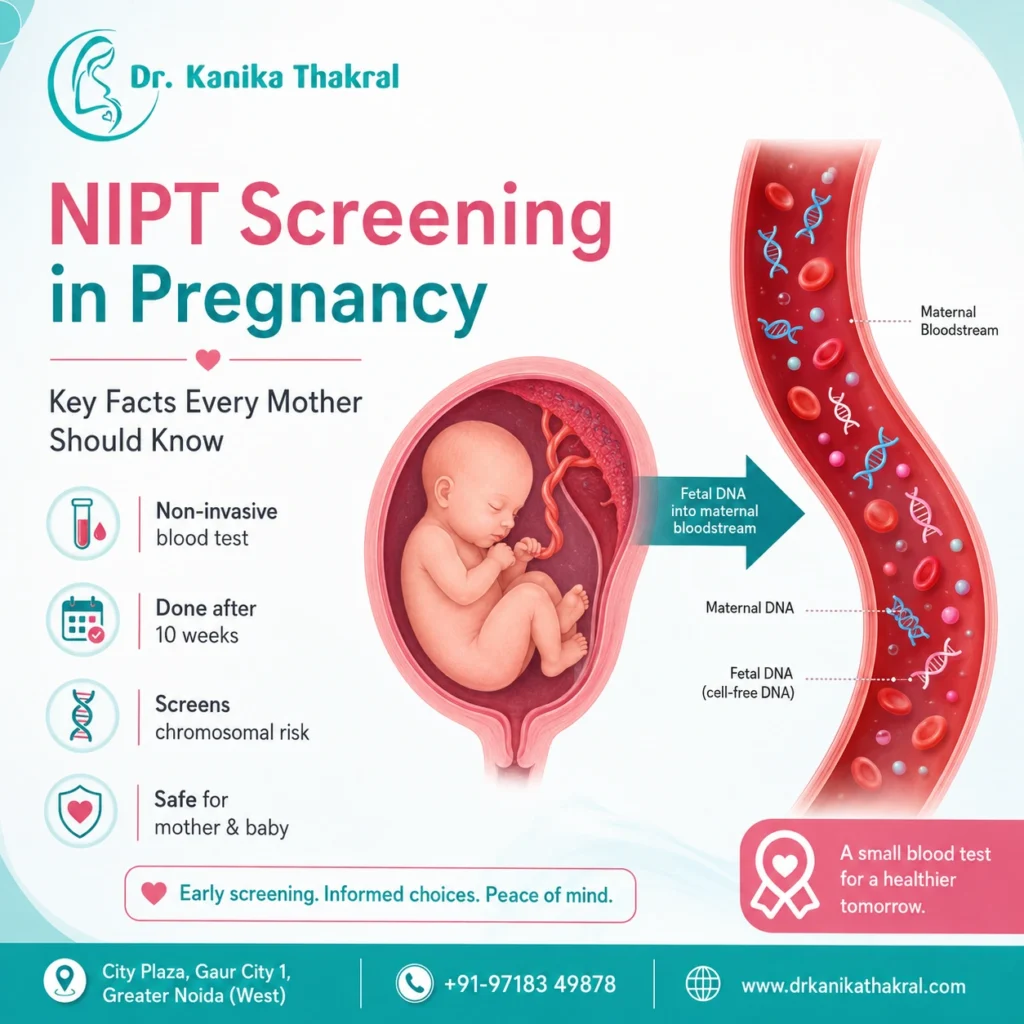
NIPT Screening in Pregnancy: Key Facts Every Mother Should Know
NIPT Screening is a blood test done during pregnancy. It helps check whether the baby has a higher chance of certain chromosomal conditions. It is also called Non-Invasive Prenatal Testing.
Many mothers feel confused when their doctor suggests this test. They may wonder if it is safe, when it should be done, and what the result really means. These questions are normal.
The test is simple because it uses only the mother’s blood sample. It does not involve putting a needle into the womb. So, it does not increase the risk of miscarriage. MedlinePlus explains that prenatal cell-free DNA screening checks DNA in the mother’s blood to find out if the baby is more likely to have conditions caused by abnormal chromosome numbers. It also states that this screening cannot confirm a diagnosis.
At Dr. Kanika Thakral’s clinic, expecting mothers get guidance for pregnancy screening, reports, ultrasound timing, Pregnancy Care, and safe pregnancy planning. If your doctor has advised this test, the right information can help you feel calm and confident.
What Is NIPT Screening?
NIPT Screening is a prenatal blood test. It checks small DNA fragments present in the mother’s blood during pregnancy. Some of this DNA comes from the placenta.
The test studies this cell-free DNA to estimate the chance of selected chromosome-related conditions. These conditions may happen when there is an extra or missing chromosome.
In simple words, this test gives a risk estimate. It may show low risk or high risk. But it is not a final diagnosis.
That is why the report should always be discussed with your gynecologist.
Why Is This Test Done During Pregnancy?
Doctors may suggest this screening to check the risk of common chromosomal conditions. It is often used because it is more accurate than many traditional screening tests.
It may help screen for:
- Down syndrome, also called Trisomy 21
- Edwards syndrome, also called Trisomy 18
- Patau syndrome, also called Trisomy 13
- Sex chromosome differences in selected cases
- Other chromosome concerns, depending on the test panel
ACOG says cell-free DNA testing is the most sensitive and specific screening test for common fetal aneuploidies. However, it is not the same as diagnostic testing.
So, the purpose is not to create fear. The purpose is to guide the next step in pregnancy care.
When Is NIPT Screening Done?
NIPT Screening is usually done after 10 weeks of pregnancy. Your doctor will confirm the right timing based on your pregnancy week and ultrasound findings.
Correct pregnancy dating is important before this test. If periods were irregular before pregnancy, your doctor may use an early ultrasound to confirm the pregnancy age.
This is why you should share your menstrual history clearly. If you had Menstrual Problems or needed Irregular Periods Treatment, tell your doctor during consultation.
Proper dating helps avoid confusion in screening reports.
Is NIPT Safe for Mother and Baby?
Yes, this test is considered safe because it uses only the mother’s blood sample. It does not touch the baby, placenta, or amniotic fluid.
There is no radiation. There is no procedure inside the womb. Also, there is no injection given to the baby.
MedlinePlus notes that NIPT analyzes DNA from the placenta in the mother’s blood and is used to screen for certain chromosomal disorders. It is non-invasive, but its accuracy can vary by disorder.
Still, the test should be done after medical advice. Your doctor will decide whether it is suitable for your pregnancy.
Who Should Consider This Test?
This screening may be discussed with many pregnant women. It may be especially useful when the mother wants more information about common chromosomal risks.
Your doctor may suggest it if:
- You are above 35 years of age
- Previous screening showed a higher chance result
- Ultrasound findings need more evaluation
- There was a previous pregnancy with chromosomal concern
- You missed earlier screening windows
- You want advanced screening after counselling
- You feel anxious about pregnancy screening results
However, not every mother needs the same test. Your doctor will guide you based on your age, pregnancy history, scan findings, and personal needs.
What Does the Test Check?
The test mainly checks chromosome number differences. Chromosomes carry genetic information. Usually, a baby has 46 chromosomes.
Some conditions happen when there is an extra chromosome. For example, Down syndrome happens due to an extra copy of chromosome 21.
Some test panels may also check sex chromosome differences. Others may include more conditions. However, a bigger panel is not always better for every pregnancy.
Your doctor will help you choose the right option.
What NIPT Cannot Tell You
This part is very important. A low-risk result does not mean the baby has no health concern at all.
This test does not fully check:
- Baby’s body structure
- Heart defects
- Brain or spine structure
- Baby growth
- Placenta problems
- Amniotic fluid level
- All genetic disorders
- All pregnancy complications
So, ultrasound scans are still needed. Your doctor may advise NT scan, anomaly scan, growth scan, Doppler, or other tests depending on your pregnancy stage.
Good Pregnancy Care includes screening, scans, blood tests, and regular follow-up.
How Is the Test Done?
The process is simple. A blood sample is taken from the mother’s arm. The sample is then sent to a lab.
Usually, fasting is not needed. Still, follow the instructions given by your doctor or lab.
Before the test, your doctor may check:
- Pregnancy week
- Ultrasound dating
- Single or twin pregnancy
- Previous screening results
- Mother’s age
- Medical history
- IVF history, if any
Once the report is ready, do not interpret it alone. Risk reports can be confusing. Discuss the result with your gynecologist.
Understanding the Result
The report usually says low risk or high risk. Some labs may use terms like screen negative, screen positive, low probability, or high probability.
A low-risk result means the chance of the screened condition is low. This is usually reassuring.
A high-risk result means the chance is higher. But it does not confirm that the baby has the condition.
ACOG guidance clearly states that cell-free DNA screening can have false-positive and false-negative results. Therefore, it should not be treated as a final diagnosis.
This is why counselling is important after every report.
What If the Result Is High Risk?
If the report shows high risk, do not panic. It only means more evaluation may be needed.
Your doctor may suggest:
- Detailed counselling
- Targeted ultrasound
- Genetic counselling
- Chorionic villus sampling, if suitable
- Amniocentesis, if suitable
- Follow-up testing based on the case
A high-risk report should always be confirmed with proper medical advice. Never make decisions based only on a lab report without counselling.
Screening Test vs Diagnostic Test
This is one of the most common doubts.
A screening test tells the chance of a condition. It does not confirm the condition.
A diagnostic test can confirm or rule out many chromosomal conditions with more certainty. Examples include CVS and amniocentesis. These tests involve taking a sample from the placenta or amniotic fluid.
Because diagnostic tests are invasive, they are advised only when needed and after proper counselling.
NIPT and Ultrasound: Why Both Matter
Some mothers think that if this test is low risk, ultrasound is not needed. This is not correct.
Both tests have different roles.
NIPT checks selected chromosome-related risks. Ultrasound checks baby structure, growth, heartbeat, placenta, fluid, and development.
That is why regular scans remain important even after a low-risk report.
NIPT After IVF or Fertility Treatment
Women who conceive after IVF may also be advised this screening after counselling. However, they should share their full fertility history with the doctor.
If you had PCOS, delayed ovulation, or hormone-related fertility concerns, inform your gynecologist. Women with PCOS may benefit from guidance from a PCOS Specialist before and during pregnancy.
Also share details of any Hormonal Imbalance Treatment, fertility medicines, or previous pregnancy history. These details help your doctor plan better care.
NIPT and Gynecological Conditions
Some women may have fibroids, ovarian cysts, PCOS, or cycle-related concerns before pregnancy. These conditions do not directly change the purpose of the test. Still, they matter for complete pregnancy planning.
If you had Fibroid Treatment or Ovarian Cyst Treatment, share your records. Fibroids may need monitoring during pregnancy, depending on size and location. Ovarian cysts may also need follow-up if seen on ultrasound.
Your complete health history helps your doctor guide you better.
Can This Test Help in Delivery Planning?
This screening does not decide whether you will have Normal Delivery or C-section. Delivery depends on many other factors.
These may include:
- Baby position
- Placenta position
- Amniotic fluid
- Mother’s health
- Labour progress
- Previous surgery
- Baby wellbeing
If pregnancy remains healthy and all conditions are suitable, Normal Delivery may be possible. Your doctor will guide the safest plan near delivery.
Emotional Side of Pregnancy Screening
Pregnancy screening can feel stressful. Waiting for results can make mothers anxious. This is very natural.
Try to remember that screening is meant to guide care. It is not meant to create fear.
A low-risk report can give reassurance. A high-risk report helps your doctor decide the next step. In both cases, proper counselling matters.
Talk openly with your doctor. Ask questions. Avoid relying only on social media or random online advice.
Questions to Ask Your Doctor
Before doing the test, you can ask:
- Is this test suitable for my pregnancy?
- What conditions does it screen for?
- What does it not check?
- When should I do it?
- What happens if the result is high risk?
- Will I still need ultrasound scans?
- Do I need genetic counselling?
- Is diagnostic testing needed in my case?
Clear answers can reduce fear and help you make informed decisions.
Why Choose Dr. Kanika Thakral?
Pregnancy screening needs clear explanation and patient-friendly counselling. Reports can be difficult to understand, especially when they include medical terms and risk categories.
Dr. Kanika Thakral provides guidance for screening reports, early pregnancy care, Menstrual Problems, Hormonal Imbalance Treatment, PCOS-related concerns, and complete women’s health support.
Whether you need report explanation, pregnancy monitoring, or delivery planning, you can consult Dr. Kanika Thakral for clear and supportive care.
Final Thoughts
NIPT Screening is a safe and advanced blood test during pregnancy. It helps check whether the baby has a higher chance of selected chromosomal conditions. It is usually done after 10 weeks and does not harm the baby.
However, it is still a screening test. It is not a final diagnosis. A low-risk result is reassuring, while a high-risk result needs proper counselling and possible further testing.
For pregnancy screening guidance, Pregnancy Care, Normal Delivery planning, and complete women’s health support, consult Dr. Kanika Thakral. The right information at the right time can help you stay calm and confident.
FAQs
1. What is NIPT Screening?
NIPT Screening is a blood test during pregnancy. It checks whether the baby has a higher chance of selected chromosomal conditions.
2. When is the test done?
It is usually done after 10 weeks of pregnancy. Your doctor will guide the right timing based on your pregnancy stage.
3. Is it safe for the baby?
Yes, it is considered safe because it uses only the mother’s blood sample. It does not touch the baby or the womb.
4. What conditions does it check?
It commonly screens for Down syndrome, Edwards syndrome, and Patau syndrome. Some panels may check other chromosome-related concerns.
5. Is it a diagnostic test?
No. It is a screening test. It gives a risk estimate, not a final diagnosis.
